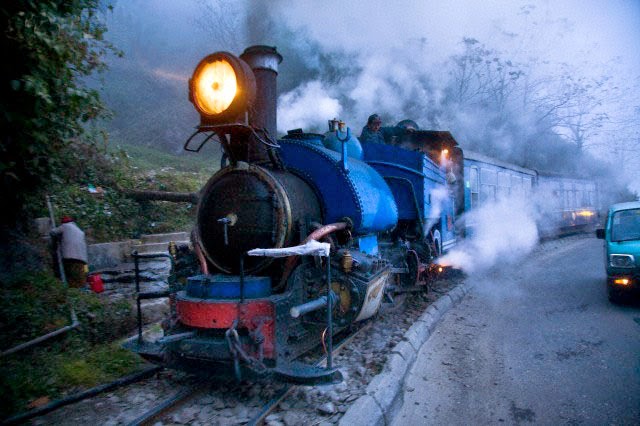
Showing posts with label Darjeeling Himalayan Railway. Show all posts

Heavy rainfall triggered landslides in NH55 and NH10, trees uprooted, toy train held up

12:02 PM
Darjeeling Siliguri, July 4: Heavy rainfall since last night triggered landslides and brought down trees along NH55 and NH10, disrupting a toy train and road traffic for hours.

Narendra Mohan, the area officer of the Darjeeling Himalayan Railway, said a tree had been uprooted and fallen on tracks and NH55, which run parallel, at Rongtong. A Darjeeling-bound toy train was held up at Rongtong for more than two hours after the tree fall.

"The diesel train with 35 passengers left NJP around 8.30am. However, it had to stop at Rongtong because of the tree uprooted in the heavy rainfall. It took almost two hours to remove the tree from the tracks and the toy train resumed its journey towards Darjeeling at 3.30pm," said Mohan.

Rongtong is 20km from here.

The uprooted tree also disrupted traffic on NH55 between Gayabari and Tindharia at one end and Siliguri at the other end.

Traffic on NH10 was disrupted for five hours as heavy rain had ripped out a tree and caused a landslide. The tree fell on the highway at Labarbotay, 55km from here, while the landslide hit the road further 20km away.
Heavy rainfall triggered landslides in NH55 and NH10, trees uprooted, toy train held up
Heavy rainfall triggered landslides in NH55 and NH10, trees uprooted, toy train held up 
"It has been raining continuously since last night and this led to landslips at several spots on NH10. The two major disruptions were at Labarbotay, where a tree had fallen on the highway, and another spot 20km further uphill. Vehicles had been stuck since noon and traffic resumed when the highway was cleared at the two spots around five hours later," said a source.

The Regional Meteorological Office in Jalpaiguri said the rainfall would continue throughout sub-Himalayan Bengal for the next few days.

"The southwest monsoon has set in and is strong over the region. This is leading to consistent rainfall in the sub-Himalayan Bengal. Heavy to very heavy rain, measuring 70mm to 200mm, has been forecast in Darjeeling, Jalpaiguri, Alipurduar and Cooch Behar districts in the next 48 hours," said a Met Office source.

In 24 hours till 8.30am today, it had rained around 70mm in Darjeeling. In other areas, the rainfall ranged between 20mm and 60mm, a Met Office source said.

Telegraph

Kalimpong, a centre of convergence: trade, town and people

1:06 AM

Writes: Diki Sherpa
[It was said that ,someday in 1940’s A wealthy man , to be specific the director of Rolex watches desired to know this place called “kalimpong” from where such an unusual high amount of Rolex watches is demanded. When the man finally arrived in Kalimpong he was rather stunned to find out the fact that kalimpong was no more than just a small chaotic trade village in the eastern Himalayas.]

In this article I had attempted to explore the distant past of kalimpong, when it was thriving under caravan trade across the Indo-Tibetan border. In this process it not only became a centre for economic enterprise but also emerged as an important converging point of people, ideas and legacies transcending their territories to produce kalimpong as a dynamic urban locale in the early twentieth century.

It all began in 1904, after the so called colonel Younghusband’s expedition to Lhasa. At this point, commerce across the Himalayas was just a mere political expression to safeguard the imperial interest. To facilitate the commerce in the region Jelepla was preferred as a principle route linking the British Empire directly with Lhasa, as the treacherous topography of Nathula did not allow the smooth mobility. Kalimpong located right in the middle of Indo-Tibetan trade route, was a point of transit- trade, replacing Kathmandu as an entrepot for the long distance trade. The goods were received in this entrepot until they were re-exported, primarily to breakdown the burden of long distance trade by single agency. Charles Bell, the British representative in Tibet notes that – “The most important of all the trade routes between India and Tibet takes off from the kalimpong in the dist. Of Darjeeling crossing south eastern Sikkim and enters the Chumbi valley by the Jelepla.” Places such as this witnessed the colossal political and economic changes over the period of time and also primarily owed their importance or rather existence to the caravan trade across the border. Trading practice and the growth of town is “incremental” and “symbiotic”, this processes cannot be seen in isolation. Kalimpong which acted as an entrepot for the Indo- Tibetan trade in the first half of the 20th century was one of such town, where trade was the very raison d’être for its growth. Commodities like woolen and cotton piece goods ,iron ,steel ,brass and copper sheets and wares, stationary ,sugar , gur, dried fruits ,dyes ,chemical ,kerosene ,candles ,lantern ,electronic torches and batteries ,brick tea , aluminum ware , porcelain ,cement ,leather goods ,cigarettes , leaf tobacco and pharmaceutical goods was sent to Tibet in exchange of musk, wool ,yaks tail, silver, gold. As often said by the locals, “almost everything” was carried to Tibet. From Tibet the raw wool constituted the 90 percent of the Tibet’s annual export to India, which in turn some of them find their way to the Indian mills and the remaining was re-exported to Liverpool and America.
Kalimpong, a centre of convergence: trade, town and people

Almost seven years since the trade started, the landscape of the area started to change. To increase the efficiency of the goods circulation, the overland traffic was mechanized, half way though. Teesta valley extension of the Darjeeling Himalayan railway was completed upto Gaillekhola (12 miles from kalimpong) and opened for traffic in 1915. The considerable effort was put to improve the cart road from Teesta bazaar to kalimpong. This “annihilation of space and time” to ensure the increased mobility of goods was directly set against the dire consequence of toiling lives of many. Considering the mountain ecologies, road construction across the asymmetrical hilly terrain presented various Ecological challenges and sometimes even cost lives. All these painstaking hard work of subalterns helped kalimpong at last to gradually glide towards urbanization. Thanks to their dreadful labor, it was no longer oblivion to the social economic and political development that was taking place beyond Teesta.

The rural setting of the was not a hindrance to the business minded individuals; it was trade all that matter. The rural setting began to get transfer and got a further impetus when Rev. J.A graham proposed to develop a Kalimpong into a town. Hence in 1916 it was declared as subdivision basically as a precondition to develop it as a town. While describing Kalimpong as a hill town, it is intriguing to point out that ,it did not presented a prototype of romantic English country home away from congestion of cities and politics of Indian plains. It certainly lacked the typical hill station characteristics like others in the eastern Himalayan or may be in the India. It did not offer a cool climate like that of neighboring

Darjeeling to develop it as a sanatorium or as a seasonal retreat with their colonial social life, gaiety and style. Moreover, even the educational institution that was established did not show any parity with the institution of neighboring hill station. The most prominent educational establishment in the region was St. Andrews colonial homes(1900) which was situated on an estate of 611 acres . The main object behind the establishment was to provide for children wholly or partly of British or other European descent, such an education and training based upon protestant principle, as many fit then for emigration to British colony or for suitable work elsewhere. Other institutions were primarily targeted to train and educate the natives of the region .In 1925 Himalayan hotel was built, the only European establishment of David McDonald to cater the European and British visitors. The total no. of European in 1941 was 529 out of total 11,958 people in town. Therefore it can certainly be said that kalimpong was not a so called favored resort of recreation. It was truly a place set aside for trade and commerce thriving with activity filled with seasonal bustling of the mule caravans to and from the Tibet.

Not so long, Kalimpong originally a hamlet, evolved as a vibrant “social space” in this process, where various individual encountered each other in the similar social and economic sphere. It became an ingress for the Tibetans to enter the outside world and gateway to enter Tibet for many foreign scholars, artists,

adventurers, missionaries. During the times of political instability, it became a major hub of information and working ground for Japanese spies, Tibetan revolutionaries, and British intelligence networks. Scholars argues that, this little town became a major gossip factory for news for the country across the border. Hence, Mr. Dorje Tharchin (Rdo rje mthar phyin) ,A Christian catechist from kinnaur , in 1925,found the location appropriate for the establishment of his press in kalimpong. It was happened to be the first long-lasting newspaper in the Tibetan language, entitled “Yul phyogs so so’i gsar ’gyur me long”, or “The Mirror of News from All Sides of the World”, and later known as “The Tibet Mirror”. It was a small publication but had a far reaching circulation and it found a wide readership in places like Assam, Darjeeling ,Bhutan ,Sikkim, Tibet, Kashmir, Almora ,Himachal and Nepal. Eventually, it became a vehicle for the dissemination of modern idea and information to the monastic land of far Tibet and adjoining areas.

However, the prosperous times were not to last forever. After 1950, with the formation of PLA and the occupation of Tibet, gradually all the wool was diverted to china and American buyers withdrew from the market. Soon after 12 years, boundary disputes and Sino- Indian war resulted into the closing of borders and the trade was brought to a complete halt. Responding to the changing political and Geo-economic transformation in the region, all the traders shifted their business to a more lucrative location and Kalimpong became a sleepy town. The reminiscences of trade still lingers among the locals, and they often temporally create the bygone years as a golden era that Kalimpong has once experienced.

This is just fragment of the whole picture that I have attempted to present, it is beyond the purview of thisarticle to compress and talk about the wider past events.

[Diki Sherpa, MPhil research scholar from the university of Delhi.]

Via DT


Darjeeling toy train cuts a man into halves near ‪Sonada‬

10:52 PM
Man Mowed Down by Train Near ‪Sonada‬

Reports: Tenzing Sangayla Bhutia

17 June 2016 Darjeeling Sonada: The World famous UNESCO's World Heritage Darjeeling toy train cuts an unidentified man in half and drags one half of the body all the way to Sonada while the other the half of his body was found near 8th Mile 4 km from Sonada.

People in Sonada were in for a shock when the Darjeeling Himalayan Railway (DHR) also known toy train pulled in tonight. Along with the train came the dead body of a male which was stuck to the lower half of the train.

People would later find that the train had cut the man in half, with half of his body being found near 8th Mile, which is 4 kms away from Sonada town and the other half got pulled along with the train to the station.

The police have cordoned off the train and are currently trying to ascertain who the dead individual is.
Darjeeling toy train cuts a man into halves near ‪Sonada‬

The Railway authorities in collaboration with the pulled out the dead body from underneath the train.
Darjeeling toy train cuts an unidentified man in halves


Via The DC

Darjeeling Toy train long distance service put on hold

2:47 PM
DARJEELING 13 Jun 2016 The Darjeeling Himalayan Railway toy train service along the 87km route from Darjeeling to New Jalpaiguri station has been temporarily suspended  after three of its diesel engines broke down a few days ago and are presently under repairs.

The DHR has four diesel engines, but three being non-functional, with the latest breakdown happening on June 10, the Darjeeling-New Jalpaiguri long distance service was forced to be suspended. DHR  area manager Narendra Mohan today confirmed that the Darjeeling-NJP service has been put on hold till the diesel engines are repaired.

“Due to technical faults, three of our engines have broken down over the past few months forcing us to halt the 87km service. We hope to resume service from Wednesday but on alternative days, as we can get only one of the three engines repaired. However, we will try our utmost to have all the diesel engines up and running at the earliest,” he said.
Darjeeling Toy train
The joy-rides on steam engines from Darjeeling to Ghoom and diesel services from Darjeeling to Kurseong and back are in operation though. Presently, there are about 14 steam engines  and four diesel engines for the DHR toy train.

Via EOI


Darjeeling toy train get glass walls for engine view

9:04 AM
Darjeeling June 8: The Darjeeling Himalayan Railway has replaced the opaque walls at the rear and front ends of two first class coaches with glasses so that travellers can see the more than century-old steam engine pull the train.

Narendra Mohan, the area officer of DHR, said the refit compartments were being used for toy trains running between Darjeeling and Ghoom since May.

He said two more coaches were also being given glasses at either ends and they would be put to use in two weeks.

"Tourists around the world come to Darjeeling to take a ride on the Unesco World Heritage railway. In order to make their ride more enjoyable and fulfilling, we have renovated two first class coaches and added glass windows at the rear and front ends. Prior to this, the coaches had opaque walls and the passengers in each of them could not see what was happening in the other coaches. But now they can easily do so," said Mohan.
The DHR compartments with glasses at the rear and front ends - file photo
The new feature has been introduced mainly to enable travellers to see how the steam engine functions. "They will now be able to see the driver operating the engine and the fireman feeding coal into the furnace," said Mohan.

"Earlier passengers could see these sights only when the train negotiated a bend. But now, they can see it anytime without having to leave their seats and rush to the windows. These coaches will be exclusively used in steam-driven joy rides between Darjeeling and Ghoom. Apart from the view in front, the tourists will also get to see the scenery behind through the glass," he added.

The coaches were renovated at Tindharia workshop - the locomotive and carriage workshop of the toy train - and the Siliguri loco shed.

While two of the coaches have already been put into use since the beginning of May, the remaining two will be in service within next fortnight.

The DHR official said the size of side glass windows of the four coaches had been made bigger so that tourists got a full view of the sceneries.

Telegraph

Darjeeling MP SS Ahluwalia stands against Discrimination against Nepali Language

8:32 AM
Darjeeling Once again we are most thankful to Darjeeling MP SS Ahluwalia who has stepped up to protect the Nepali language. Following report on social media (The Darjeeling Chronicle) MP wrote to Railway Minister Suresh Prabhu reminding him that not putting up signs in Nepali language is a violation of the Language Policy of India as well as a discrimination against the Gorkha community.

Here is the full text of the letter that our MP wrote

To 
Shri. Suresh Prabhu
Minister of Railway
Government of India

Re: Discrimination Against Nepali Language and the people of Darjeeling

Suresh ji
I want to draw your attention to the fact that the signboards that Indian Railways has put up in my Constituency – Darjeeling – has continued to violate the Language Policy of India since 2011.

The standard official language policy of the Government of India clearly specifies that, importance to be given to official State Language (only those which are also included in the VIIIth Schedule of Constitution)/regional/national languages, signboards of Railway stations in regional language, use of language on Railway Information Boards, naming of Railway stations in regional languages etc.”

Nepali was recognised initially in 1961 as an official language of West Bengal, and on 22/8/1992 as one of the Official Languages of India under the VIIIth Schedule of Indian Constitution as one of the 22 National Languages of India. Nepali is also the 1st official language for Darjeeling and Dooars region in West Bengal. DHR is still discriminated against and not featured in any of the sign boards put up by Indian Railways in Darjeeling. Not putting Nepali in these sign boards is not only a violation of the language policy of India, but also is disrespectful towards the Nepali language and also the Gorkhali community of my constituency. What is more hurtful to my constituents is the fact that Bengali which 99% of the population do not speak or read, is used as the 1st language.

On behalf of my constituents, I request you to kindly instruct the local administrative unit of Indian Railways to remove the signs that do not feature Nepali language and to put up signs in Nepali which is a Recognised regional language in Darjeeling and Dooars as well as one of the National Languages of India.

I look forward to your prompt action.
Kindest regards

SS Ahluwalia
MP, Darjeeling.
Darjeeling MP SS Ahluwalia Writes to Railway Minister - Demands Signs to be Written in NEPALI
Rule 3A of the Bengal Official Language Act, 1961 also specifically states
3A. Notwithstanding anything contained in section 3, with effect from such date-1 as the Slate Government may, by notification in the Official Gazette, appoint in this behalf, the Nepali language may, in addition to the Bengali language be used for such— (a) rules, regulations and by-laws made by the State Government under the Constitution of India or under any law made by Parliament or the Legislature of West Bengal, and (b) notifications or orders issued by the Slate Government under the Constitution of lndia or under any law made by Parliament or the Legislature of West Bengal, as apply to the three hill subdivisions of the district of Darjeeling, namely, Darjeeling, Kalimpong and Kurseong:

Provided that different dates may be appointed in respect of different matters referred to in clause (a) or (b). .

Explanation.—For the purposes of section 3 and this section the words "law made by Parliament or the Legislature of West Bengal" shall include any law made before or after the commencement of the Constitution of India by any legislature or other competent authority in the territory of India having power to make such a law.

Given this, we request the West Bengal government and all other administrative bodies to put up all the signs and instructions in NEPALI at the top.

Once again, we are grateful to our MP for stepping up to protect the dignity of Nepali language and Nepali speaking people... It is sad that none of our "intellectuals" and "sahityakkars" have so far bothered to highlight this issue.


Via The Darjeeling Chronicle

Darjeeling toy train resumes its daily train service between New Jalpaiguri and Darjeeling

9:48 AM
Siliguri, May 23: The Darjeeling Himalayan Railway will resume its daily train service between New Jalpaiguri and Darjeeling next week, more than five months after it had been rescheduled to thrice a week because of lack of diesel engines.

Narendra Mohan, the area officer of the DHR, said daily services between NJP and Darjeeling halted in January when one of the four diesel engines had developed problems.

"We had to run the services on alternate days, instead of everyday, because one of the diesel engines had developed a snag and was sent for repairs. We were short of engines and we had to reduce the number of trips on the route. Since January, we have been operating the trains on Mondays, Wednesdays and Fridays," Mohan said.

"But the engine has been restored and is back with the DHR. We will conduct trial runs to see if it is functioning properly and will commence regular services from NJP to Darjeeling by next week," he said.

Additional coaches have been attached to toy trains on the Darjeeling-Ghoom route since May 19 to cater to tourists.

"Normally, there are two first-class coaches but now there are four. The footfall of tourists has increased in the past one week. Two coaches were not enough," Mohan said. "We are planning to keep the additional coaches till June."

The four coaches can ferry around 120 passengers and the cost is Rs 630 per person.

UNESCO to Survey ‪‎Darjeeling‬ Himalayan Railway Next Month

7:43 AM
Writes: Mrinalini Sharma

A six-member Unesco team will visit the Darjeeling Himalayan Railway for five days next month to conduct a survey of the World Heritage Site.

The visit is part of formulating# a Comprehensive Conservation and Management Plan - a blue print on conservation, management and sustainable development of toy train.

Officials of the DHR said the team would be here from April 9 to 13 and visit different stations of the hill railway.

"A team of Unesco experts will visit the DHR for five days from April 9 to 13. We have been informed that this is a visit before work on formulating the CCMP begins. The team will visit all stations of the hill railway, including Tindharia workshop," said Narendra Mohan, the area officer of the DHR.

"This will be a field survey of the DHR to understand the landscape on which the heritage railway is, various components of the DHR and other important details about its conservation and management. The team will have three officials from the Unesco's New Delhi office and three Unesco experts from different countries. The preparation of the CCMP will take at least two years," he added.
Darjeeling‬ Himalayan Railway
The CCMP is mandatory for all Unesco World Heritage properties.

The master plan for the DHR will be formulated by the Unesco experts in collaboration with the Indian Railways that would provide the funds.

Unesco has said the plan should cover all aspects like institutional, legal and economic and ensure that the "Outstanding Universal Value" should be protected.

Paul Whittle, the vice-chairman of UK-based Darjeeling Himalayan Railway Society (DHRS), wrote an e-mail to The Telegraph about the visit.

"It is great news that work is about to start on this long-awaited DHR Comprehensive Conservation Management Plan, funded by Indian Railways and led by a UNESCO appointed panel of experts. This initial visit is the essential first step in a lengthy and wide-ranging study that will form the basis of a robust and lasting plan for the conservation and sensitive development of this World Heritage railway," he wrote.

"We know that UNESCO will be seeking input and recommendations from a wide body of local organizations and other bodies. The Darjeeling Himalayan Railway Society will certainly be contributing to UNESCO's work," the e-mail read.

Established in 1881, the DHR was accorded the Unesco World Heritage status in 1999.

It is the second railway in the world to be given a heritage status after the Semmering Railway in Austria in 1998.

Telegraph


Darjeeling toy rtain to add extra coaches for Christmas-New Year season

8:20 AM
Siliguri, Dec. 22: The Darjeeling Himalayan Railway will add one extra coach to each of the three diesel-run toy trains for the joy rides to accommodate tourists who flock to the hills during the Christmas-New Year season.

The additional compartments on the Darjeeling-Ghoom-Darjeeling route would be introduced from December 25.

Narendra Mohan, the area officer of the DHR, said the decision to add the coaches was taken because there had been an increase of around 10 per cent in online reservations for the joy rides since the holiday season began this time.

"We have noticed that the online reservations for the DHR joy rides have risen to around 80 per cent in the past two-three days, which is around 10 per cent more compared to the previous years. So, we have decided to add an extra coach for all diesel-driven joy rides to accommodate more tourists," said Mohan.
Darjeeling toy rtain to add extra coaches for Christmas-New Year season
A diesel-driven toy train in the Darjeeling hills. File picture
Currently, the DHR offers seven joy rides, including a steam-run Red Panda that plies between Kurseong and Darjeeling.

The six other joy rides are between Darjeeling and Ghoom.

Three trains on the route are diesel-driven and the three others run on steam.

"The reason for attaching additional coaches to the diesel-driven trains is that they (the engines) can haul up to four coaches. The steam-driven engines can pull only two compartments. We will run the extra coaches till the reservations come back to normal," Mohan said.

DHR sources said a first-class coach has 28 seats and by adding the extra coaches, 84 more passengers can be accommodated for the joy rides daily.

On December 2, the DHR had resumed the toy train service between New Jalpaiguri and Darjeeling. The route had been shut since June 2010 because of a landslide at Paglajhora.

While one train travels from NJP to Darjeeling, another one runs from Darjeeling to NJP everyday.

"The occupancy has been fairly good in the past three weeks. In fact, in the past three days, the train that travels uphill from NJP to Darjeeling had full occupancy," Mohan said.

Source: Telegraph

Week long Darjeeling Cultural and Tourism Festival 2015

8:47 AM

Tourist in the second day of the ongoing week long Darjeeling Cultural and Tourism Festival (DCTF) did what they had only watched actors do in cinemas and wished. The festival organizers gave enthusiastic tourists a thrilling opportunity, to dance on the moving Darjeeling Himalayan Railway (DHR), a first for many of them.

And willing tourists did not let go of the opportunity as some of them climbed aboard the open coach of the toy train and showed their moves. “Fifteen years back I had taken my last ride on the toy train. But, today it was an amazing and different experience, to dance on one of them with people on the streets looking at us. I felt like a movies star,” said an elated Prashant Divedhi from Kolkata.

Burdawan resident Animika Bhowkick did not dance but the ride from Darjeeling to Ghoom and back was a memorable one for her. “I am not much of a dancer so I refrained from joining the others. However, it was just as much a scintillating experience to be a part of the road show. I thank the organizers and wish them well for future, too,” she said.

The DCTF that is organized by the Gorkhaland Territorial Administration (GTA) has become an annual affair in the Hills. It is organized every year this month in November with the objective to attract tourists to the Hill station.

This year the festival is being held from November 1 to 7 in Darjeeling sub-division. Similar events will also be organized in the other sub-divisions of Kurseong, Kalimpong and Mirik, till November 8.

The cultural dance (on different Nepali songs) on the moving DHR train however will only be held for three days from today. Performers from the GTA’s information and cultural department will perform every morning for three days on the 10.40 am diesel run train from Darjeeling to Ghoom and back with a break at the Batasia War Memorial. Bhanu Kanta Ghisingh, the GTA information and cultural department assistant director said, “The idea behind having dancers from the department on the moving train is to bring to highlight and promote our cultural. Tourists can even participate with our dancing troupe, which we believe will give them a trilling experience”.

Not only tourists but the performers too were elated with the opportunity to dance on the heritage train. “I have been dancing for thirteen years but this is the first time on a moving train. This experience I will keep till my last days. Of course, dancing on moving train is never easy but I managed it all the same,” said Ram Limboo, one of the male dancers.

The festival will showcase the various culture and traditions of the Hills communities. Stalls have been put up at the Gorkha Ranga Manch Bhawan dishing our traditional delicacies and in the evening local bands will entertain tourist and locals alike for the next six days.

Source EOI

100 years of Tindharia workshop - DHR, Darjeeling Himalayan Railway

12:37 PM
1915-2015: 100 years of Tindharia Works, A UNESCO World Heritage Area
Article by: DHR Sano Rail

This year celebrates 100 years of Tindharia Works. It has always been considered a location relatively safe from landslips but this was to change in 2011.

The only background information I have of Tindharia is to be found in the late Terry Martin’s books ‘Halfway to Heaven’ and ‘Iron Sherpa’ - although I remember conversations with some local residents of the area over the past 20 years,
100 years of Tindharia workshop - DHR, Darjeeling Himalayan Railway

Until the early 19th Century, the Darjeeling Hills were heavily forested and largely unpopulated apart from the indigenous Lepcha people. I am not certain as to exactly where the area which is now Tindharia lay in relation to the borders of the kingdoms of Bhutan, Nepal and Sikkim before the British Raj purchased land around Darjeeling and Kurseong from Sikkim as sanatoriums and summer resorts.

The first roads into the area, to link Siliguri and Darjeeling, were the Pankabari Road up to Kurseong and then the Military Road across to Darjeeling. However, these were steep mountain tracks suitable only for pack horses rather than wheeled carts. The Hill Cart Road (now NH55 Tensing Norgay Road) was built around 1861 with a steady gradient up which two bullocks could haul a cart. It was largely along this formation that the DHR was constructed in 1879 - 81 to reduce the almost prohibitive cost of taking supplies up to Darjeeling and bringing down the products of the rapidly developing tea industry.

Tindharia was built as a ‘railway town’ by the DHR around its mechanical headquarters. It is said that the location, which is logistically illogical for a workshop, was chosen for being the lowest point in the Darjeeling Hills, on the DHR, where the British employees could work year round. It should be remembered that, at that time, Siliguri was just a very small settlement around the railway junction between the North Bengal Railway from Calcutta (through what is now Bangladesh) and the DHR up to Darjeeling and considered to be a most unhealthy location to spend any time.

The current workshop complex at Tindharia was not built until 1913 - 15. From 1881 until then, it is assumed that the large locomotive shed there, with the godowns around it, was also used as the workshops for major locomotive and rolling stock repairs. This would make sense as the Chief Mechanical Engineer’s bungalow and the Mechanical Department offices were adjacent to it. The original bungalow was a single storey wooden structure with a veranda, similar to many of the Tea Planters bungalows of the period, but was replaced in the mid 1940s with the current two-storey building in the then fashionable Indian interpretation of Art Deco style - which can also be seen at Darjeeling Station. The office building was destroyed during the political disturbances of the mid 1980s - although the remains still exist.

The first railway colonies were built around Tindharia station and the Locomotive Shed and include the bazaar area. Later ones were constructed further down the hill nearer to the new Workshops. I don’t know if it still exists, but the only street map I have seen of Tindharia was (2004) framed in the electric generating plant in the Workshops and also had the power lines into the town marked on it.
The opening of the new Workshops (which are just about to celebrate their centenary) coincided with the major expansion of the DHR system with new lines from Siliguri to Kishanganj (connecting with the metre gauge line to Katihar) and up the Teesta Valley (to develop international trading with Tibet at Kalimpong). Other developments at this time included the hospital at Tindharia, new headquarters offices for the DHR at Kurseong (adjacent to the station), the DHR Club at Kurseong (now All India Radio) and a new railway colony at Kurseong, which incorporating the railway officers’ residences above what is now the Tourist Lodge.

Until the DHR company sold out to Indian Railways in 1947, the method of working the line was very different to that of today. Not only were the now extinct freight facilities considerably larger (and more profitable) than the passenger services but all train operation was based at Tindharia. Therefore Tindharia was home not only to the workshop overhaul staff but to most of the routine maintenance staff, loco drivers, firemen, sanders, guards, jamader / brakesmen etc. Locomotives and their crews all started from Tindharia and worked on a cycle of diagrams which might involve spending one or more nights away from home at Darjeeling or Kurseong or Siliguri. One retired driver told me that at the height of the spring tea season, he had to make four round trips between Tindharia and Sukna each day to clear the loaded wagons off the Hills as fast as possible for a larger loco to assemble longer trains onwards to Siliguri and transhipment onto the Broad Gauge for Calcutta.

In its last year as a private company, the DHR employed at Tindharia:
• 1 Chief Mechanical Engineer
o 1 Chief Clerk
8 Clerks
1 Steno typist
1 Tracer
3 Menials
o 1 Loco Officer
1 Coal Inspector
3 Coal Clerks
30 Drivers
31 Firemen
200 Jamaders and Brakesmen
45 Jackmen and Loco Cleaners
1 Shed Clerk
2 Running Clerks
2 Callmen
o 1 Store Keeper
1 Head Clerk
7 Clerks
9 Menials
o 1 Workshop Foreman
1 Assistant Chargeman
2 Shop Clerks
2 Peons
2 Timekeepers
5 Chowkidars
88 Fitters
27 Drillers and Turners
12 Boilermakers
50 Riveters
16 Blacksmiths
14 Strikers
23 Carpenters
4 Coppersmiths
4 Tailors
16 Painters
11 Moulders
28 Khalasis
1 Tindal
1 Sweeper
• 1 Medical Officer (at Kurseong)
o 2 Assistant Medical Officers
1 Compounder
1 Nurse
1 Dresser
2 Menials
• 1 Commercial Inspector
o 2 Station Masters (including relief)
o 2 Assistant Station Masters (including relief)
12 Guards
2 Travelling Ticket Examiners
• 683 Total

This list does not include Civil Engineering and Permanent Way staff nor other Commercial passenger or freight staff based at Tindharia (as the inventory does not split the location of these establishments).

The Mechanical Engineering Department did not function as separate Open Line and Workshop divisions - only maintenance (all types) and train crews.

Although all the above employees were based at Tindharia, some of their work-output was actually for the DHR extension lines from Siliguria to Teesta Valley or Kishanganj, not the DHR main line to Darjeeling.

It is probable that the above establishment levels were much higher than those in the 1930s since the DHR had only just started reducing its operations after World War II - when road traffic was restricted, many special trains were run for the Army (both rest leave and medical convalescence in the Hills) and Tindharia Workshops was undertaking production of many Broad Gauge railway components to allow other railway workshops in India to increase output of military hardware.

Today, Tindharia is best described as a ‘ghost town’; a shadow of its former self. The DHR no longer runs services to Teesta Valley and Kishanganj or freight trains and the remaining passenger services are now based at Darjeeling and Siliguri. Only a much-reduced establishment at the Workshops, the last in India to give heavy repairs to steam locomotives and wooden bodied coaches, remains to give local employment. Even the passing trade of cars, taxis and buses up the Hill Cart Road requiring refreshments has ceased because of landslips either side of the town in 2010 - 12 and again recently.

It is hoped that the soon-to-commence UNESCO Comprehensive Conservation Management Plan (CCMP) for the DHR will recognise that all the non-railway, environmental, social and cultural criteria of the World Heritage Site listing (as well as the obvious railway elements) are summarised in the railway town of Tindharia and that a sub-plan can be developed to give the area a sustainable future and hope.

Toy train resumes Darjeeling-NJP service after 5 years

7:43 AM
 Mrinalini Sharma

World heritage, Darjeeling Himalayan Railway today resumed its full-fledged toy-train service along the whole length of 80km tracks from New Jalpaiguri (NJP ) to Darjeeling after a gap of five years.
The toy train service from NJP to Darjeeling, the most sought-after choice of tourists, has been suspended since June 14, 2010, after a major landslide swept away 500 metres of NH55 at Paglajhora - located 35km from here - and the track running parallel to it.
Darjeeling toy train
Toy train resumes Darjeeling-NJP service
Although the toy trains used to run from NJP till Gayabari, another landslide on the highway at Tindharia in September 2011 cut short the joy ride till Chunabhati. Chunabhati is 27km from Siliguri and Gayabari is 7km uphill.

The resumption of Siliguri-Darjeeling service today was a low-key affair with no fanfare. The diesel-driven toy train hauling two first class coaches and a second class one started its journey to Darjeeling from the NJP station around 8.50am with a single passenger Edward Copperman from Ireland.

"I arrived in Siliguri on Tuesday and got to know through Internet that the DHR service from Siliguri to Darjeeling would resume today after a gap of nearly five years. The toy train is very popular in Ireland and I have heard that the scenery along the route is spectacular. This is my first visit to Darjeeling and it feels great that I am the first passenger to board the Unesco World heritage train which is resuming its journey from here to Darjeeling after five years," said Copperman who works for a travel agency.

The scheduled departure of the train from NJP is 8.40am and its scheduled arrival at Darjeeling is at 4.15pm. Although the train departs from NJP, the toy-train service is popularly referred to as the Siliguri-Darjeeling service.

When the toy train reached Siliguri Junction at 10am, eight more passengers boarded the train.
Among them was Shweta Rani from Bhagalpur in Bihar, who along with her husband and two children, had come for a holiday to Darjeeling.

"We had arrived in Siliguri yesterday and were supposed to go to Darjeeling by road today. However, we got to know through Internet that the Siliguri-Darjeeling service would be starting today. So, we decided to travel by it. My children had wanted to take a ride in the heritage railway during our Darjeeling visit and their wish has been fulfilled," said Shweta.

In March 2013, Unesco - which had conferred World Heritage status on the DHR in 1999 - had rapped the Indian Railways over the delay in restoration of the tracks at Tindharia and Paglajhora and resumption of service from NJP to Darjeeling.

In February 2014, the toy train service resumed from NJP to Gayabari after restoration of the tracks at Tindharia.

"The restoration of tracks at Paglajhora was completed on December 13 last year and trial runs were being conducted since December 24. We had applied for permission to restart the Siliguri-Darjeeling service to the Northeast Frontier Railway and got it a few days back. So, we are starting full-fledged daily service from NJP to Darjeeling with passengers from today. It will be a regular service from Siliguri and online reservations will start as soon as the service has been updated in the railway reservation system. Till then, we will provide manual tickets to the passengers," said a DHR official at Siliguri Junction.

Another train service from Darjeeling to Siliguri started from Darjeeling at 10.15am today and reached Siliguri after 8pm.

Source: Telegraph,

Bimal Gurung thanked Dr Subramanian Swamy for raising Gorkhaland issue at the National level

8:00 PM
GTA
Bimal Gurung, the GTA chief  expressed his gratitude to Dr Subramanian Swamy for raising the statehood issue at the National level by  writing to Home Minister for GORKHA PRADESH and raising several other issues such as creating a post of Additional Chief Secretary and Additional DGP for the GTA (Gorkhaland Territorial Administration).

Subramanian Swamy during National Seminar on “Small States and Gorkhaland”
Senior BJP leader  Dr Subramanian Swamy had promised to raise the Gorkhaland statehood issue last week when he had been invited by the Morcha leadership in the two days National Seminar on “Small States and Gorkhaland”

GJM (Gorkha Janmukti Morcha) president Bimal Gurung on his official Facebook Page wrote the following.

"I am most thankful to Dr. Subramanian Swamy for raising the Gorkhaland issue at the highest level.
The fact that he wrote to the Home Minister to take necessary steps to form “Gorkha Pradesh” shows the significance he has placed on the formation of a separate state for the Gorkhalis in India.

In writing his letter to the Hon’ble Home Minister a day before the 1/1st and 1/3rd Gorkha Rifles complete 200 years service to the nation is reflective of the impeccable as the nation will celebrate our brave Gorkha jawans tomorrow, the Hon’ble Home Minister will be reminded of the need to give justice to the Gorkhas who have waited for 108 years for a state of our own.

I had a telephonic conversation with Dr Subramanian Swamy today where I thanked him whole heartedly for advocating our cause of a seperate state of Gorkhaland.

Dr Swamy told me that he was written to the Hon'ble Home Minister, Shri Rajnath Singh outlining various steps that can be taken towards creation State of "Gorkha Pradesh". He has sought creation of posts of Addl DGP and Addl Chief Secretary, he told me. He said that the Hon'ble Home Minister was gave a very positive response to the demand.

Dr Swamy also said that he had spoken to Hon'ble Railway Minister, Shri Suresh Prabha and raised the issue of upgrading the Darjeeling Himalayan Railways. Likewise he also drawn the attention of Hon'ble Minister for Highways, Shri Nitin Gadkari to the early restoration of NH 55 in Darjeeling and to the Hon'ble Law Minister, Shri D.V Sadananda Gowda for setting up a seperate High Court Bench in Darjeeling as a step to creation of a seperate state.

Even as I expressed my gratitude to Dr Swamy, he assured that he will continue his advocacy of a seperate state for Gorkhas in India.

On behalf of the people of Gorkhaland, I conveyed my gratitude and prayed that he will continue to support our just and fair demand of Gorkhaland State.

Time has come for us to turn the dream of Gorkhaland into a reality, and for that all of us need to work together as a team."

Source - Bimal Gurung Official

Darjeeling Toy train accident in Kurseong, one tourist dead

8:46 AM
A toy train carrying more than 50 tourists hurtled down sloping rail tracks in Kurseong yesterday as its wheels skidded, causing the death of a Calcutta lady who may have fallen off.

The alertness of a Siliguri-based businessman saved lives in the three coaches. Giridharilal Gan, a bookseller from Siliguri, turned the wheel-like emergency brake - each coach has one - as the guard on duty on the train had jumped off like several passengers had.
Darjeeling Toy train accident in Kurseong, one tourist dead
(Bottom left) The toy train at the accident spot; Giridharilal Gan (above), the bookseller from
Siliguri whose presence of mind saved co-passengers. Picture by Suman Tamang
Tourists today spoke of the horrifying "death-train-like" experience as they saw a co-passenger leaping out with a kid in her arms.

According to co-passengers, Beliaghata's Moly Pal, 51, jumped, too, but did not survive. Her brother, however, said Moly may have fallen off.

When the 57 tourists started the Jungle Safari ride from Siliguri Junction at 10.35am on Republic Day, the train was late by 35 minutes.

The to-and-fro ride from Siliguri to Gayabari in Kurseong subdivision, snaking through the Mahananda wildlife park and with a 15-minute halt before return, takes five-and-a-half hours. Tourists embarking at 10am can expect to be back in Siliguri around 3.30pm.

But as the train started late yesterday, the operators said they would not go the whole stretch up to Gayabari - 35km from Siliguri Junction - but till Tindharia, which is 30km from Siliguri. As a consolation to the tourists, the driver said there would be a stop for about an hour at Tindharia, so tourists can go to nearby shops.

Toy trains rarely move at a speed more than 20kmph, making them inconvenient for long rides or daily commute.

The train reached Tindharia at 12.45pm and started for Siliguri at 1.45pm.

Gan said: "I was in a group of 24 people and we were in the last of the three coaches. As the train was moving downhill, it seemed to have picked up speed. Then we saw a person jump off and realised something must be wrong," Gan said. "Soon, the guard, who was in our coach, also leapt out."

Seeing the guard jump off, some of the women passengers panicked and started crying. "The doors and windows were rattling. People were yelling," Gan said.

By then, some passengers had started shouting that the brakes had failed - the railways did not agree with this theory, though an official said the wheels slipped on the tracks despite the application of the brakes.

Gan said he knew there was a wheel-like emergency brake at the rear of every coach as "I have travelled in toy train several times before". "I ran to the back of the coach. I rotated the brake wheel thrice. Nothing happened, the train was still hurtling down. When I rotated the wheel the fourth time, it screeched to a halt after couple of minutes," he said.

The train came to a halt near Chunabhatti station, which is a couple of kilometres from Tindharia.

"This entire thing happened in five to seven minutes, but the experience was horrifying. Either the train would have gone off the tracks and fallen into a gorge ahead or it would have rammed into homes and shops at the side of the tracks and killed more people," the 44-year-old, who has a bookshop in Siliguri's Collegepara, said.

After the train stopped, local people helped the passengers disembark.

The driver, Gan said, was still in the engine room. "He said there had been a technical problem and that he had no way of stopping the train other than applying the emergency brake which I had done."

Nikita Saha, a Siliguri-based dentist on the train with her eight-year-old daughter Neha, said the morning "joy ride became a death ride".

She said: "Some passengers were jumping off. A lady who did that lost her life, it was horrifying." The "quick action of this gentleman (Gan) saved all of us who did not jump off," Nikita said.

Kartik Das, another Siliguri resident, said he saw "a woman jump from the first coach. Within seconds, another woman carrying a child in her lap, followed."

He said when the train stopped "we ran uphill along the tracks to locate those who had jumped off. We found the woman, who had jumped first, lying near the tracks, unconscious. The woman who had jumped after her with her child had suffered injuries but both were conscious. We called up the police."

The lady who had fallen off or jumped first was 51-year-old Moly Pal of Beliaghata.

Eyewitnesses said Moly had rammed against the wall of a house when she fell. But her brother said Moly's family on the train saw her chin hit the locomotive as she fell.

The ordeal for the passengers did not end with the ride. "There was no railway official to help us reach Siliguri. Each of us had to call for vehicles from Siliguri and we returned home in the evening," Nikita said.

A police officer later said three people suffered injuries when they jumped off.

"A woman died and three others got injured. The post-mortem was conducted at NBMCH today and her body was sent to Calcutta with her relatives," the police officer of Kurseong subdivision said.

When asked what snag led to the accident, a railway official said the wheels slipped on the tracks after the brake was applied. He refused to call it a failure of the braking system.

"There was some slipping of wheels on the tracks when the train was travelling downhill. This happens when brakes are applied forcefully in a moving train.... An inquiry committee will investigate the incident," said A.K. Sharma, the divisional manager (Katihar division) of the Northeast Frontier Railway.

Asked whether any action would be taken against the guard who had jumped off instead of operating the emergency brake, Sharma said: "I have got the information and referred it to the inquiry committee. If found guilty, we will definitely take necessary action against the guard".

Moly's family said her husband and four relatives were on the train.

"They were coming back to Siliguri. The train was coming down from the mountains at a very high speed unusual for a toy train," said Sumitava Pal, Moly's brother who stays at Siliguri. "It is not clear whether my sister tried to jump off or she fell down," he said.

Gan today said: "It's like I escaped death."

Source: Telegraph

Restore Darjeeling Himalayan Railway writes New Railway Minister to Mamata Banerjee

8:25 PM
The Darjeeling Himalayan Railway  (DHR), warned by UNESCO that it could lose its status as a world heritage site, has found fresh hope of restoring the link that can help retain that status.
 Darjeeling Himalayan Railway
 Darjeeling Himalayan Railway
New Railway Minister Sadananda Gowda has written to West Bengal Chief Minister Mamata Banerjee, according to Darjeeling MP S S Ahluwalia, who adds Gowda has sought her “cooperation” in restoring the disrupted service. The Centre would allocate the funds, while the ministries of railways and road transport (the road too needs repair) would have to work jointly on the project, the MP says quoting from the letter, dated July 23.
Built between 1879 and 1881, the 81-km, high-altitude line ran the famous Darjeeling “toy train” between Darjeeling and New Jalpaiguri and remains the only Indian railway with the UNESCO world heritage tag. It has fallen into disrepair, with landslides in Paglajhora in 2010 having dismantled 8 km of the tracks. The service continues between Mahanadi and Darjeeling at one end, and between New Jalpaiguri and Gayabari at the other.
Last year, UNESCO warned the West Bengal government and Darjeeling Himalayan Railway that the world heritage site tag would be withdrawn unless the service was restored. Subsequently, Darjeeling Himalayan Railway was allocated Rs 88 crore for restoration but the link between Mahanadi and Gayabari remains suspended. The road between those two points, too, has been snapped.
Ahluwalia then took it up again. “I wrote to the railway minister explaining the situation. He has responded and also written to Mamata Banerjee to cooperate in the restoration, and to the road transport ministry for support in rebuilding the road between Mahanadi and Gayabari,” said Ahluwalia.
DHR sources said restoration work had started after the warning but was stopped due to bad weather and labour problems in the area. North Bengal Development Minister Gautam Deb said, “We requested the central government to start restoration and allocate funds. The UNESCO team’s report said it was a highly seismic zone and the track could not be restored unless the road is rebuilt first. But the Centre did not make any effort.”
Former minister of state for railways Adhir Chowdhury blamed the state government: “After Railways allotted Rs 88 crore, the Bengal government failed to use the funds.”
According to Narendra Mohan, area manager of DHR, a pair of “jungle safari” trains runs between NJP and Gayabari while four pairs of trains run between Mahanadi and Darjeeling almost regularly. Chartered trains run on the operational track on request.

Source: indianexpress

The fading legacy of Darjeeling Himalayan Railway

8:39 PM
Unless authorities involves more and more local participation, the DHR (Darjeeling Himalayan Railway) would remain just a showpiece for Darjeeling GenNext - writes Vivek Ghatani, Senior Editor, www.indiangorkhas.in

At Kurseong Railway station above 4750 ft, tourists mostly Bengalis from south Bengal stands in queue for a railway ticket to travel in the infamous toy train. Their enthusiasm to board the train upto Darjeeling has no limits. They had heard somewhere in Kolkata that a toy train ride from Kurseong to Darjeeling is picturesque and more of it fun.
 
The fading legacy of Darjeeling Himalayan Railway


“Is this the queue for 7 a.m train to Darjeeling,” asked a gentleman not knowing exactly where to stand. Once he was informed that the queue actually is for the 7a.m daily train, a crowd of 7-8 people gathered around.

A middle aged woman finally appeared at the ticket counter bringing relief for the tourists standing in queue. One after another the tourists bought the ticket and boarded the train waiting for it customers. Once the queue finished, the ticket counter woman shut the small window before handing the chart to one of the guard.

A whistle blowed and the two compartment train pulled by a diesel engine one pierced through the congested Kurseong town heading towards Darjeeling. Smiles adorned amidst the passengers as travelling in a small train was a new experience for all.

Soon after the train left the station, I met an old friend of mine. The friend is an employee of the Darjeeling Himalayan Railway (DHR) since many years. Meeting after a long time always opens up chat. Since he is working with the DHR I inquired many things about DHR. It was no shocking to me when my friend whispered, “The DHR is running at a loss every year”.    

The fact, the story of DHR running at a loss, is often heard from its enthusiasts while the Indian Railways remains tighlipped may be out of fear of losing the heritage status accorded in 1999 by UNESCO. The Darjeeling Himalayan Railway (DHR) and its toy train with a steam engine is the only the second such railway to get the status after Festooning Railways in Austria which uses the similar steam engine.

This steam engine train built by the British in 1881 is considered to be a manoeuvring engineering work whose tracks pierces through perky hilly terrain of Darjeeling hills that starts from the foothills of Siliguri. The Darjeeling Himalayan Railway indeed still today a world famous epitome for the Queen of hills.


Inspite of the fact, people from these politically disturbed hills unfortunately has not benefitted the way it should have from this world famous epitome. As I come across meeting many people of the hills asking them has the DHR in reality served the purpose for the people to earn from it? The answers to my knowledge till today has been a big ‘NO’ that has triggered or forced us to conclude that the manoeuvring  work of the Britishers has become a show piece rather than a combination of show piece and earning epitome for the people.

The whole agimony of debate vis-a vis whether people are benefitted directly from DHR draws attention because of the fact that the hill economy is directly depended on tourism. A ‘Gorkha Bhansa Ghar’ (Kitchen of Gorkha cuisines) at Kurseong Railway station, an effort of ex-serviceman to woe tourist visiting hills by travelling on toy train has failed to attract tourists ever since its inception.

A fellow former journalist and a school teacher rightly says people from his locality in Tindharia, known to be a hub for DHR because of the place having the famous Tindharia Workshop, directly depended on DHR. “Ninty percent people from here was an employee of the DHR. Most worked in the Tindharia workshop. But the legacy is no more because of the fact that DHR is not functioning properly. After the old timers retired, there has not been recruitment anymore and the GenNext are now disinterested in toy train except a few,” he says.

People ofcourse here too formed cultural troupes to woe tourists, opened up tea stalls and eateries at various stations before finding that the National highway collapsed bringing closure to the functioning of DHR along Kurseong-Siliguri route.    

Likewise many such efforts from the local people have gone in vain right away starting from Tindharia to Darjeeling. The only reason for all this is lack of promotion both of the DHR and local efforts by the Indian Railways. In other words the Indian Railways has not been serious to develop further the world heritage status railway of India.


As a result, the fading legacy of the DHR is putting the real existence in jeopardy with people remaining least interested in toy train and its legacy. The Indian railways may be taking pride while running at a loss, but for the people this marvellous engineering piece would be nothing rather than a show piece for the GenNext of the Darjeeling hills unless the concerned authorities involves more and more local flavours so that it becomes a source of livelihood.    

Darjeeling Himalayan Railway to run toy train called Red Panda

2:16 PM
Darjeeling Himalayan Railway (DHR) will run a steam engine-driven train, toy train, between Kurseong and Darjeeling from the end of the month and the special train has been named after the red panda.

Darjeeling Himalayan Railway to run toy train called Red Panda
DHR to run toy train called Red Panda
The endangered animal was recently chosen by the Election Commission as a mascot for creating awareness about free and fair election in the Darjeeling Lok Sabha seat.

Sugato Lahiri, the chief public relations officer of Northeast Frontier Railway under which the DHR operates, today said the toy train would run on Saturday and Sundays.

“We had been thinking about starting a special train between Kurseong and Darjeeling since last year. The name Red Panda was also finalised at that time but some formalities had to be completed. Recently, we got the sanction to start the train between Kurseong and Darjeeling and the service would start by the end of the month. The train would run on Saturday and Sunday every week,” Lahiri told The Telegraph from NFR headquarters in Maligaon.

Kurseong is 38km from Darjeeling.

The special train would be driven by steam engines and have two first-class non-AC coaches.

Earlier, toy trains with steam engines ran between Kurseong and Darjeeling but for the past three-four years, the steam engines have been replaced by diesel ones.

Now, steam engines operate only on the Ghoom-Darjeeling route. Ghoom is 68km from here.

Two daily trains run on the Kurseong-Darjeeling stretch. The trains are diesel-driven and have one first class and one second class coach, both non-AC.

The DHR authorities are hopeful that the Red Panda train will generate favourable response among tourists for whom the Unesco World Heritage Railway is a major attraction.

The International Union for Conservation of Nature has listed the red panda as an endangered species.

“Darjeeling is known for its rich flora and fauna and scenic beauty. Darjeeling hills are famous for being the sanctuary of the Red Panda, which is an endangered species. Tourists come from across the country and abroad to see the animal. Darjeeling is also popular for the DHR. We thought combining the two popular items of the hills would be an attractive package for tourists. To ride in the luxury of first-class coaches drawn by a steam engine would be a rewarding experience for steam engine enthusiasts,” Lahiri said.

Source: Telegraph

Darjeeling Himalayan Railway resumed Kurseong to Mahanadi toy train service

10:16 AM
Darjeeling -Siliguri, March 25: The Darjeeling Himalayan Railway (DHR) today resumed the toy train service between Kurseong and Mahanadi, a stretch of 13km, following the repair of tracks at the landslide-hit Tindharia.
Darjeeling Himalayan Railway resumed Kurseong to Mahanadi  toy train service
Darjeeling Himalayan Railway resumed Kurseong to Mahanadi  toy train service

“We have extended the daily toy train service up to Mahanadi. From now on, the Himalaya-On-Wheels that reaches Kurseong from Darjeeling around 1.20pm, will travel 13km further till Mahanadi and return. This is a big achievement for the DHR because the track between Mahanadi and Kurseong had been lying unused for nearly four years now. Now only 6km of damaged tracks at Paglajhora remain to be repaired,” said D.S. Kunwar, the additional divisional railway manager of Katihar division, under which DHR functions.

The main aim of extending the service up to Mahanadi is to make operational a major portion of the 78km hill railway track that had been damaged by landslides along NH55 at Paglajhora and Tindharia, around 35km and 30km from here respectively.

Source:Telegraph

Darjeeling toy train service from NJP to Ghayabari resumed

11:15 AM
Darjeeling : After a gap of around four years, the Darjeeling toy train service from NJP to Ghayabari was finally restarted yesterday, but the direct journey of the toy train from NJP to Darjeeling is yet to be restored.

Steam engine Darjeeling toy train en-route to Ghayabari on Sunday.
Steam engine toy train en-route to Ghayabari on Sunday.
Notably, since June, 2010, there has been no direct toy train services between NJP to Darjeeling, as its routes and tracks are damaged at different places in Kurseong region, mainly at 14th Mile Ghayabari and below the Tindharia Locomotive workshop due to frequent landslides. On June 14, 2010 a major portion of NH-55 along with adjacent railway tracks were destroyed at 14 Mile due to landslides. Later, on September 28, 2011, a major portion of railway tracks were destroyed by a landslide below the Tindharia Railway Workshop.

But recently, the affected site near the Tindharia Railway Workshop was reconstructed with new railway tracks.  Following which the route was opened on Sunday, where a group of foreign tourists enjoyed the ride of a steam engine toy train from NJP to Ghayabari.

The reconstruction works of the routes between Ghayabari station to Mahanadi station and further upwards from Mahanadi station to Kurseong station are yet to be completed.

When asked, a senior Darjeeling Himalayan Railway (DHR) official said the efforts are on by the railway department for the early resumption of the direct train services, but until and unless the landslides affected NH 55 areas is not constructed completely, it is difficult to resume the services till Darjeeling currently.

Source:EOI


England-based Darjeeling Himalayan Railway Society pledged Rs10 lakh for its preservation

9:20 PM
DHR
The state of the Darjeeling Himalayan Railway has remained in tatters for quite a while now, but help from an unlikely quarter has raised hopes of rejuvenating the world renowned heritage of the Darjeeling hills going forward.

DHRS vice president Paul Whittle.
England-based Darjeeling Himalayan Railway Society (DHRS) has reportedly pledged the toy train Rs10 lakh for its preservation. The money will be awarded to the organisation that comes with a holistic project.

"We have collected Rs10 lakh from our members and will hand it over to the organisation that will provide us with a sound preservation project. We love the DHR and want it preserved and functional not only for foreign tourists but also local stakeholders," explained DHRS vice president Paul Whittle, who arrived in Darjeeling on Thursday.

Incidentally, Whittle also runs a tour and travel agency in England and visits Darjeeling regularly with visiting groups.

"Our commitment builds on strong relationships with our friends and partners in the Darjeeling region. We will consider a suitable project that directly helps to preserve the unique character of the DHR," he said.

The DHRS will also communicate with DHR officials for future projects that may need external support.

"We are already in talks with DHR authorities as to the type of projects they would like us to support. We are ready to extend all possible help," said the DHRS vice chairman. Whittle added he would meet the DHR divisional manager on Sunday to enquire The DHRS was founded in 1997 and boasts of more than 700 members in 24 countries working towards providing support and awareness about the DHR.

"This is the first time that we are handing out money for preservation work of the DHR. Our initial objective was to be involved only in creating awareness in various countries besides holding charity events to raise money," said Whittle.

The DHRS vice president pointed out the importance of restoring the DHR track that runs the entire length to Darjeeling from New Jalpaiguri station.

"It is important the lines get restored all the way from Darjeeling to NJP. Some stretches have been damaged by landslides," he noted.

Stretches of the DHR track was washed away in 2010 by landslides near Paglajhora, while the Tindharay stretch also got heavily damaged two years later.

"I have seen work in progress to restore the tracks and lines at Paglajhora and in Tindharay. Much needs to be done urgently even though the ongoing restoration work is impressive," remarked Whittle.

He was of the opinion that fast-tracking the restoration work would attract tourists whose love affair with the DHR has got rudely interrupted.

"I have written to senior officials requesting railway lines be opened till Tindharay from Darjeeling by the middle of this month as 60 visitors from the UK are coming only to ride on the toy train. But there has been no response so far," said the DHRS vice president.

Meanwhile, DHR officials could not be contacted for comment on the DHRS initiative even after several attempts.

Source:EOI

 
Copyright © Indian Gorkhas. Designed by Darjeeling Web Solutions