Showing posts with label Gorkha Regiment. Show all posts

BATTLE OF NALAPANI:THE ETERNAL REMINDER OF THE BRAVERY OF THE GORKHAS

6:38 PM
The Gorkhas, last year, celebrated  two hundred years of their existence in India. The world- renowned  Gorkha Rifles or Gorkha Regiment  completed 200 years of existence in April 2015. They became the backbone of the British Indian forces  after having joined  British service in 1815.

Dehra  Dun or the Doon valley, as it is popularly known,  has several interesting  landmarks of  the  eventful Anglo-Gorkha Battle(known as the battle of Nalapani or Khalanga)  of  1814-15.The Khalanga Memorial   was built by the British on the banks of the Rispana river,which flows below the Khalanga Hill,  to  commemorate their  brave soldiers as well as the Gorkha gallants whom they defeated.The fort was made of wood, red sand and stones. The new memorial there commemorates the inspiring and indomitable courage of Balbhadra and his men.

The Khalanga Memorial, a nationally protected monument looked after by the Archaeological Survey of India, is located on the road which takes tourists to the Sulphur Springs of  Sahastradhara. It was in this Khalanga-Nalapani area of the valley that a fierce battle  between the British and the Gorkhas was fought as both of  them were  eager to expand their territories.
BATTLE OF NALAPANI:THE ETERNAL REMINDER OF THE BRAVERY OF THE GORKHAS
BATTLE OF NALAPANI
In 1804 the Doon valley came under the control of the Gorkhas.Raja Pradyuman Shah of Tehri was killed by them in the battle of Khurbura in Dehra Dun. Till the battle of Nalapani took place, the valley was under Gorkha rule. After the battle, the  British Government reinstated Sudarshan Shah on the throne of a truncated part of Garhwal.

On October 31, 1814  the third infantry division under Major General, Sir Robert Rollo Gillespie, with a large force, attacked the Khalanga –Nalapani fort defended by Balbhadra Singh Thapa and his soldiers barely 600 in number.The gallant General,who is said to have been among the bravest soldiers of the British army, fell to the bullets of the defenders.

Colonel Mawby succeeded to the command  and the attack was resumed on November 25 and the fort was shelled on November 27.The British also cut off the water supply to the fort. All this forced Balbhadra Singh to decide that the fort could no longer be held. On November30, he, along with 70 of his men, evacuated Khalanga. They  opened the gate, came out of the fort and ran towards a stream nearby. The British troop was surprised to see this. After they had quenched their thirst, the brave Balbhadra said to the Britishers: "Go and occupy the fort. We have deserted it". When the British troops entered the fort they found  nothing but corpses, some dying men and children crying out “Pani,Pani” in their thirst. The Nepalese troops went away, but did not surrender before the British troops.

A Mela is held in the last week of November every year in the area to commemorate the sacrifice made by the Gorkhas during the battle. Balbhadra Singh Thapa was killed by Afghan troops when he was later in the army of Maharaja Ranjeet Singh.

 The foundation of the fort, which was razed to the ground by the British, can be seen under the thick carpet of grass on the hill and also some huge black  boulders which were once part of the fort’s walls. The incredible silence tells the story of the exceptional courage of the Gorkha men ,women and children who refused to bow down before the massive British army.

 Downhill, the original memorial of the war which was built by the British is now an enclosed space with some signages put  up by the ASI. There are   twin obelisks which stand there - one is in memory of Major General Gillispie and his officers and men , and the  other, probably the only one of its kind in the world, was dedicated by the     British to the memory of the very men they defeated- Balbhadra and his Gorkhas.

People the world over would also like to know more about the  brave Gorkhas ,who with their Khukris  and their  battle cry of “Ayo Gorkhali”, faced the huge British force at Khalanga  with exceptional valour. Developing a  Gorkha Tourist Circuit in the Doon valley would indeed be a great idea to boost historical and cultural tourism.

Via dailypioneer

Gorkha Regiment : The legendary badass warriors

6:45 PM
Writes Naba Raj Chetri

“Better to die than to be a coward" is the motto of the world famous Gorkha army, whose might and valour has transcended boundaries, but what do we really know about the gorkhas, lets try to find out.

Origins
Historically the term ‘Gorkha and Gorkhali” is derived from the hill town and district of Gorkha from where the “Kingdom of Gorkhasthan” expanded. The Gurkhas introduction to the British Army begins in 1814 during the Anglo-Nepalese war.Though the British were militarily successful, attempts to annex Nepal failed and the hostilities ended with the signing of the Sugauli Treaty. The British were so impressed with the Gurkhas fighting abilities, their loyalty and ferocity that they later encouraged them to volunteer. Gurkha troops then fought for the East India Company in its wars in the subcontinent.  The Gorkhas became an integral part of pre-independence British army. From then on, Gorkhas have been a part of Afghan Wars, Indian Rebellion of 1857, both world wars (More than 200,000 fought in both world wars, 43,000 of which lost their lives) and other United Nations peace keeping missions in Lebanon and Sierra Leone too.
British Gurkhas
The very first Gorkha regiments were raised by British to serve in British Indian army. After India’s Independence, six regiments, the 1 GR, 3 GR, 4 GR, 5 GR, 8 GR and 9 GR were retained in the Indian Army, while 2nd, 6th, 7th and 10th joined the Brigade of Gorkhas in the British Army. Another regiment was raised by the Indian Army, the 11 Gorkha, to accommodate the soldiers who refused to be transferred to the British Army.

Currently, the Indian army is indebted to the service of 40,000 brave Gorkha soldiers in 42 different battalions of 7 regiments. One of the most famous platoon of Gorkhas, 1/11 Gorkha Rifles is one of the most decorated with 11 vir Chakras, 2 Maha Vir Chakras, 3 Ashok Chakras and 1 Param Vir Chakra. The stories of its Param Vir Chakra winner Lt. Manoj Kumar Pandey are a case study in their glorious history of courageous war footings.​

Another famous battalion of Gorkhas is the third battalion of the 4 Gorkha Rifles which was instrumental in Operation Meghdoot in Siachen. The 8 Gorkha Rifles are also have a glorious past as they produced one of the only two Field Marshals for India – Sam Manekshaw. India’s current chief of army staff, General Dalbir Singh Suhag, is also from the Gorkha Regiment which is a testament of the most incredible services of Gorkhas.

The Gorkha Brigade
Facts:
i) Gorkhas has been instrumental in all Indian victories in every battle since 1948 till now.The character played by Ajay Devgan in the film LOC Kargil  (Capt. Manoj Kumar Pandey, PVC awardee) was a gorkhali of 1/11 regiment.

ii) Officers in the Gorkha Regiments of the Indian Army have to learn the Gorkhali language to be able to interact with their men in their native tongue.

iii) Recently a battalion comprising entirely of Indian Gorkhas was set up, this is the 1st time a new gorkha battalion have come up in 50 years. The Sixth Battalion of the First Gorkha Rifles (6/1GR), christened  "Kanchi Paltan" has been raised at Sabathu in the Shivalik foothills near Shimla, that houses the 14 Gorkha Training Centre.

iv) “If a man says he‘s not afraid of dying, he’s either lying or he’s a Gorkha.”This quote by Sam Manekshaw, Indian Army’s first Field Marshal, aptly describes what it means to be a Gorkha.

v) The queen has two personal Gorkha officers who directly attend official state and key events with the queen. They’ve been present in all state affairs since the Gorkha’s introduction during queen Victoria’s reign.

vi) Dalbeer Singh Suhag the current chief of army staff is also from the Gorkha regiment, he was comissoned in 4/5GR in 1974, and according to the traditions of the 5th GR wears his head gear with the strap below the lower lip. Other regiments wear chin straps below the jaw.
An interesting account need to be told here about the chin strip---
When the Gorkhas joined the British army they proved to be slight primitive in war, they always screamed and then charged at the enemies, which was harmful for launching surprise attacks. So the commander of a gorkha regiment asked his men to wear the chin strips under the lips, So that they would be reminded not to scream when they get into attack mode. The 5th Gorkha Rifles still maintains it.

The Khukri 
The Gurkha’s traditional weapon and all-around utility tool, is the powerful Khukri, an inwardly bent cross between a machete and a knife, measuring 18 inches and able to split a man’s head down the middle midway to the chest in one blow. Ghastly indeed. According to tradition, once drawn, the kukri demands blood, if not the enemy’s, then the owner’s will suffice. The regimental insignia of the gorkha regiment also consists of paired crossed Khukri.

The Khukri
Decorations
Gorkha Regiments are one of the most decorated regiments of Indian Army.They are considered finest soldiers worldwide..

Three Gorkhas has been awarded the highest military decoration "Param Veer Chakra" Which are most by any regiment of Indian army.In addition to this, various Gorkha Regiments have been awarded 33 Maha Vir Chakras, and 84 Vir Chakras besides 26 victoria cross. the British military’s highest distinction for valor,while 2,700 were awarded other medals in World War II alone. More recently, a Gurkha sergeant was awarded the Conspicuous Gallantry Cross for single-handedly fighting off a Taliban attack to his base in Afghanistan.


Recruitment
More than 28,000 Nepalese from the hills strive to become a Gurkha every year to fill just 200 places. The selection process is said to be the toughest in the world and the competition is stiff. The ranks have always been dominated by four ethnic groups: the Gurungs and Magars from central Nepal; and the Rais and Limbus from the east, who live in impoverished hill villages.


Training
As part of their training, recruits are expected to pass several educational, language and fitness tests, among them running a 3-mile uphill course carrying 70 lbs. on their backs and doing 70 sit-ups in 2 minutes. After meeting the initial age, height, weight and schooling requirements, recruits go on to the second stage for English language training, maths, fitness and an initiative test. The third stage includes: 3-month language training, military skills, Western culture and customs, general weapons training and, of course, several fitness tests.


Stories
Stories of the Gurkhas bravery and skill abound have been well documented, such is the reputation of these hardy nepali hillsmen that stories of enemy fleeing their position upon hearing rumours of their advances abound.


During the Gallipoli campaign in 1915, in the thick of World War I, the Gurkhas gained immortal fame by capturing a heavily-guarded Turkish-held position with relatively few casualties. On the Western front, a Gurkha battalion fought until the last minute and to the last man at the Battle of Loos.

Recently in India, a retired Gurkha officer travelling on a train in India found himself in the midst of a massive robbery by a band of 40 bandits. When they tried to rape a young girl, the retired Gurkha unsheathed his kukri, killed 3 bandits, injured another 8 and sent the rest fleeing.

In Afghanistan, A Gurkha on a mission to kill a “high-value target” needed proof of his mission’s success in the form of DNA, swiftly decapitated the target and brought his head in as proof instead.

Diprasad Pun  a sergenant of the Royal Gorkha Rifles single handedly defeated 30Talibans who were storming the complex, he fired 400 rounds of Ammunition, used 17 hand grenadews and a Claymore mine before battering the last fighter with the tripod of his machine gun.

Cardozo's was a major of the the 5th gorkha rifles, his remarkable military career saw him losing a leg when he stepped on a landmine in the 1971 war. He cut off his mangled leg with his own khukri and told his Gurkha man: "Now go and bury it." Determined not to let the disability affect his career as a soldier, he later became the first disabled officer in the Indian Army to command an infantry brigade. The regiment which then had 750 personels then made 7326 Pakistanis surrender.

These brave soldiers are an asset to all the nations they serve, In India every year there is a tussle in the IMA as the top cadets try to get into this regiment of the braves. Courage on war front and innumerable gallantry awards notwithstanding, the aura of Gorkhas on the field demands immense respect and makes the enemy tremble with fear.


Legend who saved Kargil, Subedar Harka Bahadur Rana, Military Cross

6:34 PM
July 26th is celebrated across India as the Kargil Vijay Diwas to commemorate the glorious victory of India over the Pakistani forces in 1999.

But what about the forces themselves? What do they celebrate?

When it comes to Kargil there is only One Hero – in fact a LEGEND who stands the tallest. As far as the forces are concerned there is One Giant who along with his brave comrades literally saved Kargil for India, and that did not happen in 1999.

It happened in 1948, during independent India’s first war.

We proud to present the story of a Gorkhali legend who has continued to inspire generations of soldiers serving in for the Indian army in Kashmir.

Subedar Harka Bahadur Rana
INDEPENDENCE BLUES
Barely few months after independence, Pakistan invaded India via Kashmir with overwhelming number of forces, and such was the disadvantage our troops were in, that India was on the verge of losing entire Kargil region to Pakistan.

The main problem was that our troops could not reach the battlefield due to lack of roads, and they had to reach Leh via Zojila , Drass, and Kargil. Despite poor facilities and equipment, hard work by our Engineers helped in moving the Tanks to reach up to the Zojila pass - in what is called THE BATTLE FOUGHT ON DONKEY TRACKS - But it was still a long way from the actual battle field.

GORKHALIS ON THE MARCH
As in Kargil in 1999 when the 1/11 Gorkhas were the First battalion to be deployed for Kargil, back in 1948 it was the 1/5 Gorkha Rifles under the command of (then) Lt. Col Anant Singh Pathania, who was incidentally the first Indian officer to command the Gorkha Rifles and win a Military Cross, began moving northwards in the direction of Kargil.

During the course of the 1948 war, the most fearful battle was fought for the then Khera bridge which connects Kargil to the rest of India and it was vital to both the sides from strategic, military and geopolitical aspects.

Since the Pakistanis had captured the Kargil area, they were well entrenched in the area with superior firing positions and well supplied armoury. On the other hand the Indian army had been on a move for a while and the supplies were not as regular, also they were in inferior positions which exposed them to firing by Pakistani troops.

THE BATTLE AT KHERA BRIDGE
The 1/5 Gorkha Rifles were engaged by a strong force of Pakistani defenders at Khera bridge over the river Shingo. The battle was so fierce and the Indian troops were so disadvantaged that at one stage of the war the capture of the bridge seemed to be by all means impossible and unlikely. Until one Gorkha soldier decided that loss or withdrawal was simply not an option.

The main problem for the Indian troops was that, the enemy were too well set and they could not keep on fighting the enemy from a distance, they needed to take the fight to the enemy or give up. The battle was fierce and most of the troops guarding the bridge were American trained Pak soldiers with heavy machine guns.

Despite all the odds young Subedar Harka Bahadur Rana and his valiant men of 1/5 GR managed to cross the Shingo river, take the fight to the enemy in the positions where they had felt invincible, and beat them into surrendering or retreating.

SUPREME SACRIFICE
Sub. Harka Bahadur and many of his friends died in the operation but the Gorkhas marched ahead till they fought up to Kargil. As one of the picture will show, before Sub Harka Bahadur and his friends decided enough was enough, it was Pakistan on the other side of the bridge, now the border is more than 5kms away.

Given that so many of our brave hearts have given their supreme sacrifice for our motherland in Kashmir, nowhere in Ladakh or entire Kashmir will you see a memorial solely dedicated to a single person. The memorial dedicated to Sub Harka Bahadur is an exception.

Sub Harka Bahadur Rana earned that rarest of the rare honour not only due to his valour and dedication for our motherland, but also for that rare indomitable spirit which turned the course of war and helped in conjoining Kashmir with India forever.

WE REMEMBER
Lt. Col. Anant Singh Pathania who commanded the mission was decorated with Mahavir Chakra, and Late Subedar Harka Bahadur Rana won Military Cross for his bravery and exploits. Today a new bridge has been built by Indian Army and is known as Harka Bahdur Rana Bridge.

In Military circles, it is said that the battle waged by Col. Phatania, Sub. Harka Bahadur Rana and their men of 1/5 Gorkha Rifles were one of the hardest battle ever fought.

While others chose to ignore or forget our brave hearts, we refuse to forget the real Legends of Kargil - like Harka Bahadur, without whom there would be no Kargil in India.

Jai Mahakali!! Ayo Gorkhali!!

[This article was published earlier in TheDC, and has been re-posted as ‪#‎KargilVijayDiwas‬ Special]

Via GYASA

Gorkha‬ Soldier martyred fighting Militants in LoC Kashmir

8:55 PM
A ‪‎Gorkha‬ Soldier from ‪Assam‬ Martyred While Stopping Militants from Crossing LoC in Kashmir Arun Kumar Rai, a 1/3 Gorkha Rifles jawan hailing from Burha Burhi village, ‪Sadiya‬ in ‪‎Tinsukia‬ district of Assam was martyred on Monday along the Line of Control (‪‎LoC‬) in Jammu and Kashmir's ‪‎Kupwara‬ district when the army battled guerrillas who tried to sneak in from ‪Pakistan‬.

Army’s 1/3 GR and 100 battalion of Border Security Forces (BSF), who are manning the fence at 3 BEHAK forest area near Jumgund in Keran sector, intercepted heavily armed group of militants last night at around 12.30 am.


Arun Kumar Rai, a 1/3 Gorkha Rifles martyred fighting Militants in LoC Kashmir
Arun Kumar Rai, a 1/3 Gorkha Rifles martyred fighting Militants in LoC Kashmir 
After being challenged, the group of militants believed to be infiltrators opened fire resulting in an encounter in which an Army jawan identified as Naik Arun Kumar Rai sustained serious bullet injuries. He was immediately evacuated to military hospital in the frontier of district. However, he succumbed to his injuries.

Army said that they have killed two Al- Badar militants in an encounter at Nowgam sector in North Kashmir’s Kupwara district.

(TNT News)


Indian Gorkha Kumar Thapa the only Indian to scale Mount Everest and reach South Pole

11:45 AM
A Siachen warrior: This is the first Indian man to reach Mt Everest and South Pole

Writes Sushant Singh 

“I want to be the first Indian man to complete The Three Poles Challenge.”

Arjun Kumar Thapa is the only Indian man to have reached the top of Mount Everest and South Pole. But, he has also done what many others who have reached both these places won’t ever be able to do: two stints at the Siachen glacier.

A Havaldar with the Gorkha Regiment of the Indian Army, Thapa completed the feat on May 20, when he scaled the Everest as part of a 30-member Indian Army Massive Everest Expedition: 2016. This team will be ceremonially flagged in by the army chief in New Delhi on Tuesday.
Two Indian twins, Tashi and Nungshi Malik, daughters of a retired army officer, had achieved the feat last year when they reached the South Pole.

Thapa, 34, had reached the South Pole in Antarctica as part of an eight-member army team on January 15, 2011. The team had covered the distance of 1170 km in 50 days of skiing.
Speaking exclusively to The Indian Express, Thapa said that “even though both are glaciers, the two challenges are totally different. The journey to South Pole is on a flatter terrain, with gradual slope and there is no problem of oxygen. The climb to the peak of Everest has more obstacles, particularly the icefalls like the Khumbu icefall.”
Arjun Kumar Thapa is a second generation soldier, whose father had also served in the Gorkha regiment.
Thapa is a second generation soldier, whose father had also served in the Gorkha regiment.
While travelling to South Pole, Thapa said that the challenge is to remain fit for 50 days of skiing, with little time for recovery. He had achieved the feat during the period of six months of continuous daylight at Antarctica, which made rest even more difficult. “For the first week, I couldn’t even sleep in Antarctica. But then you get tired and you start sleeping,” says Thapa, father of a one-year-old son.
On the climb to Everest, he says that there is enough time for recovery but there is always a danger for life and safety. In 2016, so far, six climbers have lost their lives and more than 25 rescued after going down with frostbite and hypothermia.
A Havaldar with the Gorkha Regiment of the Indian Army, Thapa completed the feat on May 20, when he scaled the Everest as part of a 30-member Indian Army Massive Everest Expedition: 2016.
His two stints at Siachen, one at the Siachen Battle School from 2013-15 and the other at Southern Glacier with his battalion from 2006-08, were of great help in his climb to South Pole and Mount Everest. In 2012, he was part of the team which opened the route at Siachen Glacier from Bhim to Shiyagra Complex. “You get used to living at a glacier and it also toughens you mentally for any hardship. There can be no better preparation than that,” says Thapa, proudly wearing the Everest badge on the left pocket of his army uniform.

Lt Colonel RS Jamwal, the team leader of the Everest expedition team and a three-time Everest climber says that “the expedition was a particularly successful one, with 14 of our team scaling the peak at Everest, as planned by us. We had no casualties. Five of our boys also successfully participated in the Everest Marathon, the highest marathon event in the world.”
The Everest Marathon is an annual event held on May 29, to commemorate the day
Edmund Hillary and Tenzing Norgay first climbed the Everest.
The Everest Marathon is an annual event held on May 29, to commemorate the day Edmund Hillary and Tenzing Norgay first climbed the Everest. The 42-kilometre race starts from the Base Camp at 17,500 feet and ends at Namcha Bazaar at 12,000 feet. The Indian participants completed the race in a time of 5.30 to 6 hours, Jamwal said.

Having reached South Pole and Mount Everest, what is next challenge for Thapa? “The North Pole”, the soldier replies, “I want to be the first Indian man to complete The Three Poles Challenge.”


Via indianexpress


शहीद अश कुमार गुरुंग पंचतत्त्व में विलीन

10:31 PM
सोलन। पाकिस्तानी आतंकवादियों की घुसपैठ को नाकाम कर प्राणों की आहुति देने वाले शहीद लांस नायक अश कुमार गुरुंग शुक्रवार को पंचतत्त्व में विलीन हो गए। सुबाथू के श्मशानघाट में पूरे सैन्य व राजकीय सम्मान के साथ उनका अंतिम संस्कार किया गया। सामाजिक न्याय एवं अधिकारिता मंत्री कर्नल धनी राम शांडिल ने भी सुबाथू पहुंच कर शहीद को श्रद्धांजलि अर्पित की।

बता दें कि, चार दिन पहले जम्मू-कश्मीर के तंगधार क्षेत्र में पाकिस्तानी आतंकवादियों ने भारतीय सीमा में घुसने का प्रयास किया था। दूसरी तरफ से जब गोलीबारी आरंभ हुई तो सीमा पर तैनात गोरखा राइफल्स के जवानों ने मोर्चा संभाल लिया और आतंकवादियों का डटकर मुकाबला करते हुए आतंकियों को खदेड़ दिया। लेकिन, इसी बीच गोलीबारी में भारतीय सेना के दो जवान शहीद हो गए थे। इनमें से एक 3/1 जीआर के लांस नायक अश कुमार गुरुंग थे। बुधवार को उनका शव हेलीकॉप्टर से सुबाथू लाया गया था और नेपाल से उनके परिजनों के आने की प्रतीक्षा की जा रही थी। शुक्रवार को परिजनों के सुबाथू पहुंचने के बाद शहीद का अंतिम संस्कार किया गया।
इससे पहले शहीद के शव को तिरंगे में लपेट कर श्मशानघाट तक पहुंचाया गया। इस मौके पर सामाजिक न्याय एवं अधिकारिता मंत्री कर्नल धनी राम शांडिल ने शहीद के शव पर पुष्पचक्र अर्पित कर उन्हें भावभीनी श्रद्धांजलि अर्पित की। 14 गोरखा प्रशिक्षण केंद्र के कार्यवाहक कमांडेंट कर्नल एचपी सिंह सहित समस्त सैन्यअधिकारियों व जवानों ने शहीद को सलामी दी।
Shaheed Ash Kumar Gurung  3/1 Gorkha Rifles
Shaheed Ash Kumar Gurung 

Via eenaduindia

Subash Ghisingh stood for the separate Indian Gorkha Troops

12:51 PM
Shri Subash Ghisingh always stood for the separate Indian Gorkha Troops, so as to differentiate the “Indo – Nepal Agreement Troops” and the “Indian Gorkha Troops” and to save the whole settled Indian Gorkhas from unnecessary and permanent stigma and allegation of Foreigners, Mercenaries, Reciprocal people and Nepal subjects.

Finally after 30 years on 2nd April 2016, The Army have raised a new Gorkha battalion comprising entirely of Indian Gorkha troops i.e. Sixth Battalion of the First Gorkha Rifles (6/1GR), named “Kanchi Paltan”. Traditionally, the majority of troops in Gorkha regiments belong to Nepal, The stipulated ratio of composition of these regiments between Nepalese and Indian domicile Gorkhas is about 70:30:

Why the need of separate Indian Gorkha Regiment / Battalion?

The separate Indian gorkha regiment or battalion is required so as to have clear distinction between the “Agreement Troops” (the gorkha troops from Nepal / Nepalese citizen) and the “Indian Gorkha Troops ( The gorkha troops from Indian / Indian citizen )”

The Indian Gorkhas had faced and are still facing the unique identity crisis with regard to their Indian citizenship because of the Indo-Nepal Treaty of Peace and Friendship (1950) which permits "the citizen of Nepal or India, the freedom to reside, own the property, participate in trade and commerce and other rights of similar nature in their territory”. Thus, there are many Nepalese citizens of Nepal who have migrated after 1950 living in India. The Indian Gorkhas are mistakenly identified as the citizens of Nepal who have migrated to India in search of jobs and livelihood.

Whereas the history of Indian gorkha starts from The Gorkha War (1814–1816), the war that was fought between Gorkha Kingdom ( Nepal ) and the British East India Company which ended up by signing the Treaty of Sugauli in 1816.
The Sugauli Treaty was signed on 2nd December 1815 and later ratified on 4 March 1816 between East India Company and King of Nepal: however, the treaty asked for the territorial concessions, in which large territory of Nepal was given to British India, and also allowed British to recruit Gurkhas for its military service.


Under the treaty, about “one-third of Gorkha Kingdom (Nepal)” was lost, including Darjeeling, Sikkim, territory to west of the Kali River like Kumaon (present Indian state of Uttarakhand), Garhwal (present Indian state of Uttarakhand); some territories to the west of the Sutlej River like Kangra (present day Himachal Pradesh); and much of the Terai Region, It caused Nepal to lose about “105,000 km2” of its territory.

Later on in 1947, when British India got its Independent creating India and Pakistan, the fate of Indian gorkha was neglected and remained unresolved as Nepal didn’t accepted it back or demanded its lost territory nor did Indian accepted it constitutionally to be its Union of State by declaring these gorkha dominated areas (territory which had come to British India as per Sugauli Teaty) as a state of Gorkahaland, a state which would uphold the identity of Indian gorkha, like the states of Wes Bengal for Indian Bangalis or Punjab for Indian Panjabi.

But rather India signed an agreement with Nepal in 1950 which created the confusion on citizenship of entire gorkha settled in India, the gorkha who had come along with their ceded land to British India began to be called as foreigner on their own homeland in present India.


Hence, Shri Subash Ghisingh not only led the movement for separate state of Gorkhaland, which he believed would resolve our identity crisis in Indian; But also demanded for the separate Indian Gorkha Regiment for Indian Grokha so as to have clear cut distinction between Indian Gorkha and Nepali Gorkha,

Historical archive below :

Date: 15th January 1987:

Telegram sent To Shri Rajiv Gandhi, P M of India, Copy to King of Nepal:

We have no other alternative but to ask the whole settled Indian Gorkhas not to join the “Agreement Troops” of Gorkha Rifles. Furthermore, we are compelled to ask the central Government of India to immediately establish a New and Separate India Gorkha Regiment so as to save the whole settled Gorkhas from unnecessary and permanent stigma and allegation of Foreigners, Mercenaries, Reciprocal people and Nepal subjects.

Date: 3rd February, 1987: Statement released:

Urging government for formation of separate “Indian Gorkha Troops” to save guard the Indian Gorkha community and in the larger interest of Indian.

Date: 22nd July 1987:

Letter To Rajiv Gandhi PM, India:

Point No 9, (iii) The “Indian Gorkha Regiment” must be established as soon as possible so as to make a clear distinction between the “Agreement Troops” and the “Indian Gorkha Troops” in the interest of the victimized Gorkha and in the interest of the country of Indian. After declaration of the Government Notification on the issue of citizenship, the recruitment of the aboriginal and the settled gorkhas to the “Agreement Troops” must be immediately stopped.

However MOS was signed 23rd August 1988 between Subash Ghising (President of GNLF) and CG Somiah (Union Home Secretary) in presence of Sd/ Buta Singh (Union Home Minister) in Delhi:

As regards raising a separate Indian Gorkha Regiment, the policy of the Government of India of not having any new regiment raised on class composition was acknowledge. However, it was clarified that it is not obligatory for Indian Gorkhas to join only specified Gorkha Regiments and that they have the option to join the Regiments of their choice. To this extent suitable instructions will be issued by the Army Headquarters…….

Finally now after 30 year of struggle the government of Indian understood the strategic need of Indian Gorkha battalion to uphold the gorkha regiment FOREVER in India. We view this STRATEGIC decision, not only an employment opportunity BUT also a clear cut distinction between Indina gorkha and Nepalese gorkha citizens.


Source HAMRO APPA

Historical First Gorkha Regiment gets new Battalion 6/1GR

9:32 PM
CANDIGARH April 1st: The historical First Gorkha regiment of the Indian army has raised a new battalion on Friday at Subathu Cantonment, which is the birth place of the First Gorkha Rifles in Himachal Pradesh. The move is historical as the Gorkha regiment has raised a new battalion after a gap of almost five decades. As of now First Gorkha Regiment has five battalions and the new battalion would be known as 6/1GR (6/1 Gorkha Rifles).

The announcement about the raising of this battalion was made by Lt Gen Ravi Thodge, Master General of Ordinance and Colonel of the Regiment in October 2015 during the grand celebrations of Reunion-cum-Bicentenary of the Regiment.

First Gorkha regiment was raised on April 24, 1815 at Subathu Cantonment. The raising celebrations included wreath laying, special sainik sammelan and prayers at the regimental mandir to invoke the benign blessings of Goddess Durga. Lt Gen Ravi Thodge conveyed his best wishes to all ranks of newly raised battalion and exhorted them to perform at their best and to serve the nation in a manner befitting the magnificent Indian Army.
Historical First Gorkha Regiment gets new Battalion 6/1GR
He also brought out that a modern and professional Indian army has to always be ready for any challenges that come its way. Colonel Avaneesh Chambial, has been appointed as the first commanding officer of the new battalion.

Via TOI

India offers to send its Gurkhas to Brunei

7:11 PM

Britain’s last military outpost in the Far East may be at risk amid reports India has offered to send its Gurkhas to protect the Sultanate of Brunei, a role currently performed by the British Army.

The tiny oil-rich sultanate of Brunei was a British protectorate for almost a century, and has continued to pay to host a battalion of British Army Gurkhas since independence in 1984.

But in recent years Brunei has found itself caught up in a struggle between its larger regional neighbours including India and China over the South China Sea.

On an official visit ending on Wednesday, Indian vice-president Mohammad Hamid Ansari signed a bilateral defence agreement involving joint military exercises and training, in part designed to shore up Brunei against Chinese claims on its disputed maritime territory.

Sources present at the meeting told The Indian Express that India had also offered to provide troops including retired soldiers from its own Gurkha Regiment, potentially supplanting the current role of the British Forces Brunei.

The claims will raise fears over the future of a deal in which the Sultan pays tens of millions of pounds annually to support a 1,000-strong British Army presence that informally guarantees his rule.

It comes at a time when the Sultanate is making swingeing defence cuts as its economy reels from plummeting global oil prices.

Officials briefed after the meeting that a team from Brunei would shortly visit India to “identify areas" of cooperation.

An Indian foreign ministry spokesman did not deny the reports, but said the proposal was “not a firm offer” and could be limited to provision of bodyguards rather than active military.

India is keen to build stronger ties with many Southeast Asian countries as part of a ‘Look East’ strategy designed to counterbalance China’s expansion in the region.

Energy-hungry India also imports large amounts of oil and gas from Brunei, while the sultanate is home to a 10,000-strong Indian community.

During the Sultan of Brunei’s visit to Chequers last February, David Cameron signed a deal to renew the presence of the Royal Gurkha Rifles in Brunei for another five years.

A Number 10 spokesman said at the time: "The PM noted that the garrison enables the UK to provide a permanent presence in South Asia while also providing an opportunity for British forces to undertake extreme environment training.”

Britain keeps a battalion of the Royal Gurkha Rifles in Brunei in an agreement with the Sultan, and keeps another battalion in Folkestone.

The Sultanate also has a separate military which includes a reserve Gurkha unit, made mainly of former British Gurkhas who decided to stay on in the country after retiring.

A defence source said it would likely be this reserve force that would be affected by any deal with India.

The source said: "There's absolutely no question that the Royal Gurkha Rifles battalion is going to replaced by Indian Gurkhas."
A Ministry of Defence spokesman said: "The employment of forces from other countries in Brunei is a matter for the Government of Brunei."

Via DefenceNews

94 year old Gorkha 2nd world war veteran no more

2:02 PM

Mr.Rabi lall Gurung , aged 94 is no more ,he breath his last breathe yesterday night in his own native place at Polok, Borong busty few km from Ravong town Sikkim.

About Mr.Rabi lall Gurung 
He fought 2nd world war as a British Gorkha army , 3rd Gorkha regiment with Germany and other allied Nation, after winning the 2nd world war in 1945 he took VRS from the service. Then he came back to his own native place to help and to uplift the society. Later he worked as a panchayat President, he did lots of work to uplift his village like he established committee school, night school and many more at the time.

He was very keen to work for the society as well as to share his experience like life in army and to give valuable suggestion what he gain from other countries.

Share by Damber S. Gurung(grand son).

Gorkha Regiment India's Most Badass Regiment, Nightmare For the Enemies

2:00 PM
Gorkha Regiment Is India's Most Badass Regiment And A Nightmare For Our Enemies

Writes Anshul Gandhi

“If a man says he‘s not afraid of dying, he’s either lying or he’s a Gorkha.”

This quote by Sam Manekshaw, Indian Army’s first Field Marshal, aptly describes what it means to be a Gorkha. Indian Army Gorkhas are meant to be fearless and as any military personnel worth his salt would know, they are also the most worthy warriors of the Indian Army.

Courage on war front and innumerable gallantry awards notwithstanding, the aura of Gorkhas on the field demands immense respect and makes the enemy tremble with fear. Their personal weapon is a ‘Kukri’, which is a 12-inch long curved knife and can be found with every Gorkha rifle personnel. The Kukri or Khukri is also embedded in their badges attested on the uniform.
Gorkha Regiment India's Most Badass Regiment, Nightmare For the Enemies
Gorkha Regiment India
The Gorkhas became an integral part of pre-independence British army after British General Sir David Ochterlony saw the Gorkha men fight against the British East Indian Company. From then on, Gorkhas have been a part of Afghan Wars, Indian Rebellion of 1857, and other United Nations peace keeping missions in Lebanon and Sierra Leone too.

After independence, out of the 10 Gorkha regiments at the time, six joined the Indian army. An 11th regiment was re-raised post-independence after many men from 7th and 10th regiment which had defected to the British army, joined the Indian army.

Currently, the Indian army is indebted to the service of 40,000 brave Gorkha soldiers in 42 different battalions of 7 regiments. One of the most famous platoon of Gorkhas, 1/11 Gorkha Rifles is one of the most decorated with 11 vir Chakras, 2 Maha Vir Chakras, 3 Ashok Chakras and 1 Param Vir Chakra. The stories of its Param Vir Chakra winner Lt. Manoj Kumar Pandey are a case study in their glorious history of courageous war footings.

Another famous battalion of Gorkhas is the third battalion of the 4 Gorkha Rifles which was instrumental in Operation Meghdoot in Siachen. The 8 Gorkha Rifles are also have a glorious past as they produced one of the only two Field Marshals for India – Sam Manekshaw. India’s current chief of army staff, General Dalbir Singh Suhag, is also from the Gorkha Regiment which is a testament of the most incredible services of Gorkhas.

On this Republic Day, we salute these brave men of the Gorkhas for their courage and sacrifice, may they bring more glory to our nation!

Source mensxp

Passing Out Parade of 216 new recruits held at 58 Gorkha Training Centre

8:07 PM
India Blooms News Service 

Kolkata, Jan 19 (IBNS): The Indian government on Tuesday said 216 Gorkha youths have been inducted in the Indian Army.

The Passing Out Parade of Recruit Batch No 170 was held at 58 Gorkha Training Centre recently.

"The parade symbolises the culmination of training and transformation of a person into a young soldier.  A total of 216 recruits of 5 Gorkha Rifles and 8 Gorkha Rifles took oath of affirmation in the solemn and impressive ceremony," read a government statement.

The parade was reviewed by Brigadier RS Thakur, Commandant 58 Gorkha Training Centre and trophies – Manekshaw Trophy and Gen Dutta Trophy - were awarded to the young soldiers who performed exceedingly well in various disciplines of their military training.
Passing Out Parade of 216 new recruits held at 58 Gorkha Training Centre
Gorkha recruits take oath during passing out parade - file photo
The parents of young soldiers were also honoured with the ‘Gaurav Padak’ in recognition of  their contribution to the Nation.


Source: indiablooms


Remembering Gorkhas on VIJAY‬ DIWAS

8:41 AM

On ‪‎VIJAY‬ DIWAS: We Remember and Salute Our Legends

To those who don't know about it, Vijay Diwas‬ is when 93000 Pakistani terrorists surrendered to 5000 Indian soldiers on ‪‎Dec16‬ 1971.

Amongst the various paltans that participated in the war for Bangladesh liberation, the ‪Gorkhas‬ have stood out  through their unparalleled bravery, sheer grit and determination, and won the platitude of laurels in not just India, but across the world.

Highlighting three major battles that the Gorkhas fought and won….

5/11 GR – BOGRA : THE BATTLE OF HILLI OR THE BATTLE OF BOGRA

Amongst the Gorkhas, the Fighting Fifth 5/11 GR won for themselves the Battle honour “BOGRA” for itself. In fact the battle honour Bogra and theater honour East Pakistan was bestowed to the 5th only.

In the Indo - Pakistani war of 1971 the 5th battalion was instrumental in liberating Bangladesh, In the operations of East Pakistan, the 5th had secured the Bogra town for 20 mountain division, in one of the most daring operations Lt Teja Bedi and his Gorkha troops had single-handedly captured the headquarters along with the Commanding Officer and RMO of the prestigious Baluch Regiment of East Pakistan.

The regimental flag of 52 Baluch Regiment is still HUNG UPSIDE DOWN in the officer’s mess of the 5th and is one of their prized possession.

4/5 GORKHAS: THE BATTLE FOUGHT WITH ONLY KHUKURIS

One great initial battle of the war fought at Atgram to break the outer crust of Pakistani defences in the East opposite Sylhet sector needs revisiting. The battalion tasked was 4/5 Gorkha Rifles (Frontier Force) which went on to capture Gazipur and eventually single-handedly took the surrender of the Sylhet garrison.

Not before and not since has any battalion launched a full scale assault employing just the Khukuri and guile alone. After getting their orders, by 5am the fierce Khukuri assault had silenced Pakistani Maj Alvi’s Bravo Company. In the mopping up, nearly 45 bodies were found scattered around the main position.

The heroes of this silent battle were Rifleman Dil Bahadur Chhetri, whose Khukuri accounted for eight Pakistan soldiers, and was awarded the Maha Vir Chakra; Rifleman Phas Bahadur Pun and 2nd Lieutenant Hawa Singh received posthumously, the Vir Chakra; and Captain Pravin Johry (posthumously) and Subedar Teerth Bahadur Gurung won the Sena Medal

[More details: http://bit.ly/1Rn8BJa]

4/5 GORKHA RIFLES (FRONTIER FORCE) - OPERATION OF SYLHET GORKHAS

The 4/5 Gorkhas were not to be left behind and were the 1st Indian troops to mount a Heliborne operations.

On a conservative estimate, the Heliborne Operation of Sylhet Gurkhas (4/5 Gorkha Rifles (Frontier Force)) made it possible for Indian Army and Mukhti Bahini to reach Dacca much earlier than planned; at least by 8 days.

On the 16th, when the surrender ceremony was going on at Dacca, Sylhet Gurkhas were celebrating with a toast, in honour of three fold success of the Battalion:

1. First Ever Successful Heliborne Operation of Indian Army, which tied the two brigades from the 7th to the 15th of December. 
2. Surrender of two Pakistani Brigades (202 and 313) on 15th December 1971. 
3. First major surrender to own forces in the Eastern Theatre. 
But the fourth larger toast, unknown to them at that time, was reserved for surrender at Dacca, which was thought unattainable.

For 'Early Dacca Surrender' was made possible by Sylhet Gurkhas tying down the Pakistani Meghna River Brigade (313), in addition to 202 Pak Infantry Brigade at Sylhet from the 7th to the 15th.

However, the degree of valour and contribution to the early creation of free Bangladesh, credit also goes to the men of the Sylhet Gurkhas, but not without a price. The cost of glory over the 27 days (20th November to 16th December) was not meagre.

Thirty one (4 Officers, 3 Junior Commissioned Officers, 7 Non-Commissioned Officers and 17 Riflemen) sacrificed their lives. Ironically one officer (Major Puri) and one Rifleman (Rifleman Kanta Bir Thapa) were injured during the 1965 War also, but this time they sacrificed their lives.

Another 122 (7 Officers, 2 Junior Commissioned Officers, 32 Non- Commissioned Officers and 81 Riflemen) were injured. A total of 153 casualties, including 11 Officers, constituted nearly 25 percent of the Battalion strength, out of which 55 were leaders at different levels (Officers, Junior Commissioned Officers and Non-Commissioned Officers); nearly 8 percent of the Battalion strength. This was the leadership and lead provided by Company, Platoon and Section Commanders.

Sylhet is the Battle Honour of The Sylhet Gorkhas and East Pakistan as Theatre Honour and nobody can deny that Heliborne Operations by Sylhet Gurkhas lead to early surrender at Dacca in December 1971.

[More details: http://bit.ly/1O7v4K2]

We SALUTE the bravery of our troops, and celebrate their great legacy.

While others may forget…. WE REMEMBER!!

Source : TheDC

Separate India Gorkha Regiment : Subash Ghishing

8:46 PM

Shri Subash Ghisingh always stood for separate Indian Gorkha Troops reason being to differentiate the “Indo – Nepal Agreement Troops” and the “Indian Gorkha Troops” and for greater interest of India, there were series of talks and correspondence regarding this issue:
15th January 1987, Telegram sent To Shri Rajiv Gandhi, P M of India, Copy to King of Nepal:
We have no other alternative but to ask the whole settled Indian Gorkhas not to join the “Agreement Troops” of Gorkha Rifles. Furthermore, we are compelled to ask the central Government of India to immediately establish a New and Separate India Gorkha Regiment so as to save the whole settled Gorkhas from unnecessary and permanent stigma and allegation of Foreigners, Mercenaries, Reciprocal people and Nepal subjects.
3rd February, 1987 Statement released:
Urging government for formation of separate “Indian Gorkha Troops” to save guard the Indian Gorkha community and in the larger interest of Indian.
22nd July 1987, Letter To Rajiv Gandhi PM, India: 
Point No 9, (iii) The “Indian Gorkha Regiment” must be established as soon as possible so as to make a clear distinction between the “Agreement Troops” and the “Indian Gorkha Troops” in the interest of the victimized Gorkha and in the interest of the country of Indian. After declaration of the Government Notification on the issue of citizenship, the recruitment of the aboriginal and the settled gorkhas to the “Agreement Troops” must be immediately stopped.
MOS was signed 23rd August 1988 between Subash Ghising (President of GNLF) and CG Somiah (Union Home Secretary) in presence of Sd/ Buta Singh (Union Home Minister) in Delhi.
As regards raising a separate Indian Gorkha Regiment, the policy of the Government of India of not having any new regiment raised on class composition was acknowledge. However, it was clarified that it is not obligatory for Indian Gorkhas to join only specified Gorkha Regiments and that they have the option to join the Regiments of their choice. To this extent suitable instructions will be issued by the Army Headquarters.

Recent political Scenario: 
13th May 2008 “No More Gurkhas for India” Prachanda has asked the Indian state to stop the recruitment of Nepalese into the Indian military.
20th March 2012 – Times of India “Nepal may ban Gorkhas from joining foreign armies” Rajat Pandit, "As per our information, it's a proposal being studied in Nepal as of now...no final decision has yet been taken. We are tracking it closely," said a senior defense ministry official on Monday.”
21st March 2012 – Hindustan Times:
“Gorkha soldiers from Nepal who have been an integral part of the Indian Army for over six decades could soon become a thing of the past and a glorious chapter of valor and sacrifice by soldiers of a friendly neighbour would come to an end”
23rd January 2015: Daily Mai News :
“Stir in Indian army as Kathmandu mulls Gorkha ban”
Nepal government set to impose ban on joining Indian army by Gorkhas as Social media video of martyr Ram Bahadur Gurung generates acute breach amongst Indian army units.
Nepal’s communist Chief have been urging ban of Gorkhas in Indian army for quite sometimes further recent shift of foreign relation of Nepal from Indian to China and ongoing protest of Madhesis in Nepal which Nepal accuse India or BJP of providing logistics support to the movement of Madhesis (Indian origin Nepali) against the Nepal Government; Further the ongoing supply cut of petrol, diesel, domestic LPG and jet fuel by Indian and China coming in to supply 1,000 tonnes fuel to Nepal are seen as series of event which are creating rift between two countries.
Therefore the announcement made on 29th October 2015 to raise an additional battalions for Indian Gorkha is a strategic decision taken by ministry of defence (India)
The Army has several Gorkha regiments— 1GR, 3GR, 4GR, 5GR, 8GR, 9GR and 11 GR, with five battalions each. The stipulated ration of composition of these regiments between Nepalese and Gorkhas of Indian domicile is about 70:30. “The Army’s plans are that each Gorkha Regiment will raise an additional battalion, which will be done in a phased manner, beginning with 1 GR,” said Lt Gen Thodge. Unlike in the past where Gorkha battalions comprised troops primarily from Nepal, the new battalion, designated as the Sixth Battalion of the First Gorkha Rifles (6/1 GR), will comprise Gorkha troops of Indian domicile (Indian Gorkhas), that is, those settled in the hilly regions of northern India and the North-East.
Finally after 28 years, Indian government have now understood the significance of separate Indian Gorkha Troops for the safeguard of India and the Gorkha Regiment itself, what Mr Subash Ghisingh did in 1987 “The Great political foresighted Leader” Hamro Appa !
Jai Gorkha, Jai Gorkhaland !

Writes Gorkhas N Gorkhaland

Assam regiment to replace Gorkhas

9:32 PM

 The signboard in front of the quarter guard on Mhow's Mall Road, which carried information on Battle of Lushai Hills, will soon impart information on Battle of Jessami. The 2nd battalion of Assam regiment is replacing the 4/1 Gorkha regiment in Mhow and the process of handing over of charge is on. 

Mhow military station has premier army training institutions and as per the requirement, Army War College and Infantry School are supported by Infantry battalions. Thus two battalions are deployed in Mhow, one for each of the two institutions. A battalion of Gorkha Regiment is deployed for Army War College and that of Sikh Light Infantry Regiment for Infantry School. 

These battalions are stationed here generally for two to three years . Along with these Infantry battalions, a squadron of Armoured regiment, a battery of Artillery and a company of Mechanized Infantry are also stationed here for demonstration of their capabilities for the training purpose. 

While the Gorkhas were deployed, the signboards carried details of Lushai Battle and other prominent battles they had fought. Lushai battle was a great success for 4/1 Gorkha regiment. There was a lot of disturbance in the Lushai hills which comprise areas of present Mizoram and Tripura states in the late 1860s. Gorkha battalion was deployed in 1871 and it was given battle honours for Lushai battle. 

The signboards will now carry details of the battles won by Assam regiment, one of them is Battle of Jessami - a memorable incident for Assam regiment. It was the first battle with the Japanese on Indian soil. On March 27, 1944, the troops of Assam regiment fought a fierce battle with the 31st Division of Japanese army. Battle was significant as it led to strengthening of defence at Kohima, which played a major role in turning the tide of the Second World War in favour of the allied forces. The Assam regiment was raised in June 1941 by the British to counter the threat of Japanese invasion of India as the route to India was through this north-eastern part of the country. Since its raising, the regiment has won seven battle honours in British India while one honour in post-independence era. 

The major components of the regiment are Assamese, Nagas, Mizos and tribes of Arunachal Pradesh while two battalions of the regiment also have Dogras, Garhwalis and Gorkhas. The tribal character of the regiment helps its troops in excelling in mountain and jungle terrain. The insignia of the regiment is the one horn Rhinoceros and its motto is Assam Vikram, which means unique valor.

Source timesofindia

1/11 Gorkha Rifles celebrates raising day on September 1st

2:21 PM
Every year 1/11 Gorkha Rifles celebrates their raising day on 1st September as the regiment  1/11 Gorkha Rifles was raised on 01 Sep 1960 at Clement Town, Dehradun. he troops of the battalion are essentially RAIS and LIMBUS, a famous and dreaded Khukri wielding stock.
1/11 Gorkha Rifles celebrates  raising day on 01 September
1/11 Gorkha Rifles celebrates  raising day on 01 September 
They are known for never having been subjugated by any king or invader and their warrior qualities are very much in evidence to date. Since its raising, "The First" has taken part in almost all operations, which the Indian Army has participated be it in East, West, North or even abroad. The battalion was awarded the first coveted unit CITATION for operations in the North-East in 1993 and the crowning CITATION for its glorious action in capturing KHALUBAR at 17,000ft in Batalik Sector, during OP VIJAY in 1999. The FIRST has got the singular privilege of being conferred with the title of BRAVEST OF BRAVE for Capt Manoj Kumar Pandey being awarded PARAM VIR CHAKRA (Posthumous) and Lieutenant Puneet Nath Datt being awarded ASHOK CHAKRA (Posthumous).

The Martyrs of the Regiment are: -

OP VIJAY
Rfn Sunil Jung Mahat - 15 May 99 LNk Ram Kr
Pradhan - 26 May 99
Rfn Lichon Pradhan - 08 Jun 99 Capt M K
Pandey - 03 Jul 99
Hav Ganga Ram Rai - 03 Jul 99 Rfn Karna Bdr
Limbu - 03 Jul 99
Rfn Kalu Ram Rai - 03 Jul 99 Rfn Arun
Kumar Rai - 04 Jul 99
CHM Jhanak Bdr Rai - 04 Jul 99 LNk Tika Dhwoj
Lawati - 06 Jul 99
Rfn Jit Bdr Limbu - 11 Jul 99 Rfn
Raj Kumar Rai - 11 Jul 99
LNk DN Shrestha - 11 May 99

OP MEGHDOOT
Rfn Shamsher Tamang - 13 Aug 98 Rfn Passang
Shrestha - 03 Sep 98
Rfn Mana Hang Subba - 07 Dec 98 Rfn Arun
Kumar Rai - 04 Jul 99

OP RAKSHAK
Lt Puneet Nath Datt - 20 Jul 97 LNk Debi
Kumar Limbu - 04 Aug 97

NAGA HILL
Capt B Subramaniam - 09 Sep 68 Nb/Sub
Chhabi Lal Limbu - 09 Sep 68
Maj MMS Bajaj, SC - 09 Jan 69 LNk
Bom Bahadur Limbu - 04 Aug 69
Rfn Parsu Ram Rai - 04 Aug 69

MIZO HILLS
Rfn Maita Bdr Rai - 17 Jun 69
WEST BENGAL (RADHIKAPUR)
Rfn Bir Bahadur Limbu - 18 Jun 71

OP CACTUSLILY
Rfn Jai Prasad Limbu - 08 Dec 71 LNk Kul
Bahadur Rai - 08 Dec 71
LNk Bir Bdr Gurung - 11 Dec 71 Rfn
Chandra Bdr Limbu - 08 Dec 71

OP PAWAN (Sri Lanka)
2Lt Ramesh Rawat - 06 Jun 89 Nb Sub
H C Sawan - 18 Aug 89
Hav Amir Rai - 18 Aug 89 Rfn
Suk Bir imbu - 18 Aug 89

Via - pib.nic.in

Gorkha shooter Jitu Rai conferred Arjuna Award 2015

9:58 PM
Aug 29, 2015: Gorkha shooter Jitu Rai was today conferred Arjuna award. He received the prestigious award from, Pranab Mukherjee, the president of India in a glittering ceremony at the Rashtrapati Bhawan. The Arjuna Awards are given by the government of India to recognize outstanding achievement in National sports.
Gorkha shooter Jitu Rai conferred Arjuna award 2015

28-year-old Champion pistol shooter Jitu Rai,had won an Indian record seven medals starting June last year, the most recent being the bronze in 10-metre air pistol event at the ISSF World Cup in South Korea last month.

Recruited in the 11th battalion of the Gorkha regiment, Rai clinched the gold medals at the 2014 Commonwealth and Asian Games and a silver at the ISSF World Championships in Spain, which helped him earn a quota place for next year's Rio Olympic Games.

In all, the (retired) Justice V K Bali led panel had recommended 17 names for Arjuna.

Following is the complete list of names of Arjuna Arjuna awardees 2015

  1. Manjeet Chhillar -Kabaddi Award
  2. Abhilasha Shashikant Mhatre - Kabaddi Award
  3. Sandeep Kumar - Archery Award
  4. Sreejesh Ravindran - Hockey Award
  5. Rohit Sharma - Cricket Award
  6. Sawarn Singh - Rowing Award
  7. M. R. Poovamma - Athletics Award
  8. Jitu Rai - Shooting Award
  9. Srikanth Kidambi - Badminton Award
  10. Anup Kumar Yama - Arjuna Award for Roller Skating
  11. Yumnam Sanathoi Devi - Wushu Award
  12. Mandeep Jangra - Boxing Award
  13. Sathish Sivalingam - Weightlifting Award
  14. Bajrang Kumar - Wrestling Award
  15. Dipa Karmakar- Gymnastics Award
  16. Babita Kumari - Wrestling Award
  17. Sharath Gayakwad -Arjuna Award for Para-Swimming
The Arjuna awardees received statuettes, certificates and award money of Rs.5 lakh each.


Gorkha Tiger’s daughter waits to don dad’s uniform

6:45 PM
On the grey, misty morning of January 29, an 11-year-old in a brown jacket marched up to her hero father's coffin. She snapped into a salute and filled the air with a full-throated cry: "Tiger 9 GR Ko! Ho Ki Hoina? Ho, ho, ho. (Was he the Tiger of 9 Gorkha Rifles?)"
Munindra Nath Rai's daughter
Munindra Nath Rai's daughter
The stiffness in her saluting hand melted in an instant and she broke down as braveheart Colonel Munindra Nath Rai's Gorkha Rifles colleagues punched the air: "Ho, ho, ho (Yes, yes, yes. He was)." Venue, Delhi Cantonment. Occasion: Homecoming of a gallant officer who was martyred fighting terrorists on January 27, only a day after he was decorated with a gallantry medal.

It's been seven months since Alka saluted her father's bravery and filled the nation's heart with pride. Today, she's her family's strength. Late Colonel Rai's wife, Priyanka often runs her fingers over his uniform. It fills her with sadness. But Alka doesn't let her mother cry: "I won't let his uniform go waste. I'll join the Army, alter this uniform. I'll wear his uniform," she says.

Colonel Rai always wanted to join the Army. Born and brought up in Kalimpong, north Bengal, where his father was an NCC instructor at the Army School, Rai would wear his NCC uniform all day and say: "I'll join the Army and serve the country."

Priyanka recalls how duty was Rai's priority. When floods drowned J&K, Rai, then in Delhi on vacation, returned to help his jawans. He had three days of leave left. Work pressure was immense, but Rai never talked operations at home. Priyanka, a heart patient, says her caring husband never wanted her stressed. "I lived a civilian's life before marriage. I knew nothing of how the Army operated but always worried for his safety. He went for many high-risk missions but never uttered a word of that at home. He always returned with a smile," she recalls.

Col Rai will be awarded the Shaurya Chakra on Saturday. Priyanka's eyes light up as she recalls their last vacation. "He was posted at Tral and we hardly got time together. Last summer we visited him. I'll treasure those days." The couple was to complete 14 years of marriage on January 31.

His colleagues talk of the firm officer with a soft side, who loved to dance and crack jokes. "He cleared the Wellington Staff College in his first attempt. His unit often referred to him as a high-flying officer. Had he lived, he would have done so much more for the nation," says Priyanka.

Rai commanded the 42 Rashtriya Rifles in Tral for two years, always putting the safety of his jawans before him. The locals too loved him. "The area's children knew him. He kept chocolates in his vehicle to distribute among kids," Priyanka remembers. His lesson to his children was to live honestly and embrace humanity. He is survived by three children, two daughters — Alka (11), Richa (9) and a son Aditya (6).

Rai's children understood his responsibilities. "They missed him but hid their sadness from him. When he was out on risky missions, they'd be scared but never bothered him. They're proud to be a martyr's children. But my son keeps telling me that if there are no militants, no father will die like this," Priyanka says. Colonel Rai was decorated with the Yudh Seva Medal. He also served in Bengal, Assam and Surankote.

Rai's last WhatsApp status summed up his philosophy: "Itni shiddat se apna farz nibhao ki purdah girne ke baad bhi taaliyan bajti rahein" (Do your duty such that the applause doesn't stop even after curtains)."

Source- timesofindia

Gorkhas performed khukuri dance in Indo-Pak War golden jubilee

10:12 AM
The soldier displayed their martial arts skills as part of the programme commemorating the golden jubilee of the 1965 Indo-Pak War. A large number of visitors witnessed the performances.

Organised by the Western Command, Sikh soldiers presented gatka while Gorkhas performed khukuri dance during the show “Hamari Army, Hamari Shaan”.
Gorkhas performed khukuri dance in Indo-Pak War golden jubilee
Gorkhas khukuri dance - representational pic 
A military band from the 14 Gorkha Training Centre, Subathu, and pipers and drummers from the Ladakh Scouts were also present on the occasion. A stall disseminating information on the recruitment process in the Army was also set up.

Large hoardings displaying various aspects of the 1965 war, including major campaigns and gallantry award winners, were also put up. A fitness programme, “zumba fitness’, based upon aerobic-like movements was also presented. Weapons and equipment were also displayed.

Lt Gen KJ Singh, General Officer and Commanding-in-Chief, Western Command, was the chief guest on the occasion. A large number of serving and retired officers, including Lt Gen Harbhajan Singh, Lt Gen Depinder Singh and Lt Gen KS Bajwa, all veterans of the 1965 war, were present on the occasion.

Source - Tribune News Service

Citation of Colonel Lalit Rai VrC, commanding officer of 1/11 Gorkha Rifles during Kargil 1999

10:53 AM
Lalit Rai, VrC is a former officer of the Indian Army who was tasked with capturing the strategic heights of Khalubar in the Batalik sub-sector during Operation Vijay, Kargil War.

I am a third generation in the Indian Army and that too in the same Regiment. After I was commissioned, I joined the 11 Gorkha Rifles, the Regiment that my grandfather and father belonged to - it's like a tradition. I got commissioned into the 7/11 Gorkha Rifles. This incidentally, was not the battalion that I led into battle. The battalion I was destined to lead, into a fierce series of battles during 'Operation Vijay' was the 1/11 Gorkha Rifles, the one my father had been commissioned into about 42 years ago. I had been posted to various places, served in every type of terrain conceivable - from deserts, mountains, jungles, ravines, plains, high altitudes, super-high altitudes - you name it. And after various instructional and staff appointments, took over the command of the 17 Rashtriya Rifles (Maratha LI), a newly raised battalion in J&K, designed to combat insurgency and militancy. Command of a Rashtriya Rifles battalion is considered a very tough and a challenging assignment. I had promptly agreed to the offer for the command of the 17 RR.
Colonel Lalit Rai along with Officers & Jawans of the 1by11 Gorkha Rifles with captured weapons of the Pakistan Army
Operation Vijay happened in Kargil, while I was busy combating militants elsewhere in the same state. This was somewhere in the first week of May 2001. By the time the actual fighting developed, it was almost the end of May and by now the people had realised that the Pakistani Army was fully involved and it wasn't just some militants. The 1/11 Gorkha Rifles had the privilege of being the first battalion to be rushed in for 'Operation Vijay'. At that point of time, my 'Colonel Of The Regiment' contacted me. He said, "The previous Commanding Officer of 1/11 GR has taken premature retirement and gone, the battalion is presently in the thick of battle," and asked, "Would you like to take over the fight and do something about it?" Lieutenant General J B S Yadava, AVSM, VrC, VSM, who is presently the Deputy Chief Of Army Staff, was also my commanding officer in the 7/11 Gorkha Rifles when I was a young officer. I was his Adjutant and I had really learnt a lot from this veteran and Vir Chakra award winner of the 1971 Indo-Pak War. He probably had faith in me and was banking on me to do something for the battalion in that difficult hour.
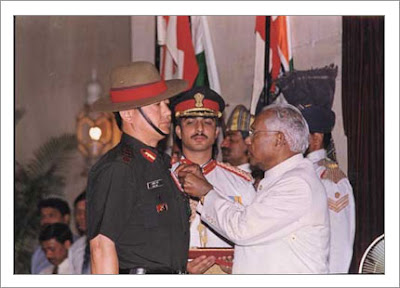
Lalit Rai receiving the Vir Chakra
I didn't hesitate and I said, "Definitely." But he also added, "I know it is unfair on my part to ask you to take up this tough assignment, especially when the Officers, Junior Commissioned Officers and the troops are new to you."

Remember, I was coming back to the Regiment after serving with the Rashtriya Rifles. Even the terrain was absolutely new to me, the information about the enemy at that point of time was not adequate; things were not all that clear. I wasn't exactly in a very enviable situation. I had however convinced myself that I would take a chance. I was anyway combating uncertainty day and night. Earlier, I had this huge guesthouse to myself in the Doda district and every night I used to sleep in a different room, as we used to be under rocket and machine-gun attacks regularly. In fact, when days passed by without some firing or some incident, I used to feel that something was missing! All that of course changed later, as they never even dared to venture anywhere near us. We had successfully managed to dominate our area of responsibility fully, after months of relentless & successful operations against militant groups.

Once I accepted the offer to command the 1/11 Gorkha Rifles, they moved me by helicopter within 48 hours and dropped me bang in the middle of the battle-zone. Many operations were going on in full swing at various places in the front. The moment I landed at the base, there was heavy shelling by the enemy artillery and my reception party ran helter-skelter for cover. My reception was now complete with the enemy also chipping in with their artillery shelling. All of us, of course had to dive for cover, this gave me an indication of the difficult times that lay ahead of us. In a month's time through vigorous effort, I improved and consolidated my battalions posture against the enemy. I got to know the boys, visited every piquet and reconnoitred the complete area of responsibility. By June-end I had learnt a lot about the enemy and his capabilities and was now adequately prepared, given the situation.

In the Batalik sector where my battalion was now located, the terrain was really tough and unforgiving, compounded with the most inhospitable weather. After due deliberation and reconnaissance everyone, right up to the highest commander, had more or less assessed that if the formidable and dominating enemy position at Khalubar was to be captured, the complete area would become more or less untenable by the enemy. But the problem was that Khalubar was located at an altitude of 17,500 feet above sea level, with the enemy sitting well entrenched, with lethal and sophisticated weapons in a dominating position, it was also located deep in the heart of the enemy defences. This implied that the attacker would be under enemy fire right from the word go. The attack would also have to be made uphill under accurate and intense enemy fire. The next logical question was who is going to capture it and how? When I volunteered for this seemingly impossible task, people thought I had gone bonkers!

I led my battalion to battle from the front, into one of the fiercest battles of 'Operation Vijay'. As a commanding officer you are expected to be sufficiently forward with the troops, but not actually lead the assault like I did. The main role of the Commanding Officer is to plan and coordinate well and provide good leadership at all times. Being new I really had no choice but to lead physically from the front on that fateful day of July 1999. It took us 14 hours of extremely torturous and dangerous marching with heavy loads of arms, ammunition, winter clothing, and other special equipment for negotiating the steep snow covered slopes, rations, etc. to reach the objective. Throughout the move we came under heavy enemy small arms fire and artillery shelling. The intensity and the accuracy of the enemy's fire grew even as we laboriously plodded our way up through snow and sharp jagged rocks at steep inclines. The prevalent temperature at this time was about minus 29 degrees Celsius. A real marrow chilling temperature, which numbs your whole body and deadens the senses.
We had started the attack with a few hundred people. We had closed in to about 600 yards of the enemy position, when the firing became very intense and effective and it seemed impossible to proceed further against this curtain of lead and fire from the tracer bullets. You could see the bullets and rockets hurtling towards us with fearsome intensity and sound. My heart still shudders when I remember the heart wrenching screams and cries of my boys who fell under this wilting fire from the enemy's heavy machine gun as also from his air defence gun. The sight of my boys battered, torn and ripped apart by machine gun fire, bleeding profusely, still haunts me, and I often wake up sweating and gasping for air from such nightmares. It was a real test for me, egging the boys on, towards almost certain death, from effective and intensive enemy fire. To close in with the enemy and finish him off before he finished us off.

At this point of time I focused myself totally to the immediate task ahead of me - to capture the objective and nothing else. All thought of the family and home was totally blocked out, to rule out even one percent chance of any weakening in my resolve. We pushed ahead despite heavy casualties with approximately 30 to 40 soldiers whom I could muster. The others were either injured or pinned down by heavy enemy fire. Maximum casualties were being caused by fire coming from Khalubar Top while the other was from a flank, which, we later named 'Bunker Area'. I decided to capture the top, with the 40 men I could muster, and sent Captain Manoj Pandey to capture and silence Bunker Area with approximately 30 men. We charged up towards the enemy position, chopping enemy heads en-route, and succeeded in capturing the top. When I took a quick head count on top, there were only eight of us left, who were fit enough to fight.

 It was literally an uphill task, almost like a scene straight out of Charge of the Light Brigade! The gradients we had to negotiate were between 75° and 80°! It was snowing and extremely cold. The rock that we were climbing was of the jagged variety that chops you to the quick if you make one false move! To top this worst-case scenario possible, there was that enemy fire coming on us right from the top! The enemy could see our every move from the top! But my Gorkha boys really proved their worth in gold and were unstoppable, I have to doff my hat to my boys! Where normal guys would have had a tough time even walking in those altitudes, my boys sprinted! They charged up and when we were at close quarters with the enemy, my boys did what they had been dying to do for so long, they removed their khukris and started chopping enemy heads. As we charged up, I could see the heads rolling down. When the Pakistanis saw that - they couldn't hold themselves any longer. They just got up and started running away. It was a sight to behold! 5 foot tall Gorkhas jumping up and chopping off the heads of these strapping, 6 foot tall Pathans, who were fleeing in sheer terror.
 So like I mentioned earlier, we were just eight of us, bang in the middle of an enemy position. It became imperative that we hold on to it. It was equally critical for the enemy to push us out because we were not only dominating their replenishment route i.e. for additional arms and ammunition, rations and things like that, but we were also cutting off their route of retreat. So they launched counter attack after counter attack and there I was, with eight chaps holding on resolutely and repulsing attack after attack. It was almost an impossible task. The enemy would muster up about a platoon (about 30 to 40 troops) and start creeping up slowly and attack us! And with just eight guys, you can imagine just how thin my defence was! Any direction of attack would have only met with one or two rifle fire, however I had all eight guys facing every counter attack. And that was only possible because on a parallel mountain spur, a few kilometres away, I had my troops holding defences against the enemy. So the company commander, whose company was on the other mountain spur, was watching our desperate stand through a pair of binoculars and he became my eyes from that side. He would tell me, "Sir, there are now 40 chaps to your left coming at you through the big boulder…" and we would shoot those guys down. And I'm pretty sure that the Pakistanis haven't yet figured out as to how we managed to know their exact route up. I'm sure they must have thought that we were almost a company atop this position.

Quite a few of us were already injured; I had got a bullet in my leg and splinters in my calf and had begun to bleed profusely. Towards the end, a situation arose where I had only two bullets left with me in my rifle - and that rifle belonged to my dead radio operator. In my hurry and concern for my boys and the task, I had literally taken off in my full uniform and I had even forgotten to remove my red collar dogs. I realized my folly much, much later…when I was in the thick of battle. So when I found out that I was down to the last two bullets, I made a quick resolve, one bullet for myself when it comes to that. As for the other one, I decided to take one Pakistani chap with me before I went. My boys were also quite tensed up, when they all realised that our moment of reckoning was finally staring us in the eye. I mean, when you realize that your death is arriving within a few minutes time, it becomes that much more agonising and difficult. On the other hand when you don't know, and death comes to you suddenly, it is okay and is probably a part of life. But here it was approaching us in another few minutes….so I quickly bid a mental goodbye to everyone I held dear to me. I was suddenly woken up from my reverie by the crackle of my radio set. It was my officer from the other mountain position, with a frantic message, "Sir, I can see about 35 Pakistanis moving up for another counter attack…" I thought to myself, "Boy! This is it; the moment has finally come to say adieu!"
My boys also looked at me for some reaction, I could feel the palpable tension in the air. I have always believed: a dash of humour can really relieve a lot of tension in your life. I had to alleviate their tension quickly and firm their resolve to fight to the end. The Pakistanis - were cursing and using the choicest of abuses even as they advanced, I gave it back to them in equal measure, with all the Punjabi that I knew. I turned to my boys and said, "Dushman tumhare Commanding Officer Saab ko gaali de rahe hain aur tum log chup-chaap baithe ho?!" (The enemy is hurling abuses towards your Commanding Officer and you boys are just sitting quietly?). Now the funny thing is that a Gorkha Johnny doesn't know how to give gaalis (abuses), and as far as discipline and obedience goes, he is unmatchable. So they looked at each other and I could read the look in their eyes, it said, "Saab ne hukum diya hai toh gaali dena hi padega." (Our Sir has given us an order and thus we will have to give abuses). They looked around and wondered, who could perform this difficult task, and finally nominated one amongst them to give the gaalis. He got up and bellowed seriously, "Pakistani kutta, tum idhar aayega toh tumhara mundi kaat degaa!" (Pakistani dog, if you come here we will cut your mundi!). I turned around and told him, "The Pakistanis will surely die…but they will die laughing that Gyan Bahadur can't even give proper gaalis!" They all broke into laughter and that kind of revved them up and got their josh back up again…and they all said, "Abo tah kukri nikalera taeslai thik paarchhu." (We will take out our khukris now and sort him out and fight).\

I radioed the Artillery Officer attached with us, located on the other mountain spur of 'Kukarthang' and asked him whether he knew where I was, and he replied in the affirmative. I then asked him to use me as a reference and give me several rounds of rapid-fire support. He was shocked! He tentatively wondered whether I really wanted him to direct our own artillery fire, approximately 100-odd rounds on my head. We are talking about the Bofors round with its devastating effect - its such a powerful gun! I had to take a chance; I preferred to die there by own gunfire, rather than get captured by the enemy. And by now, even the enemy knew that our ammunition was running low…and as the seconds ticked by, the enemy crept closer and closer 40 yards…35 yards…25 yards…and…I yelled at him and said that I didn't have the time and to just do what he was told! He did and I could hear the deadly whistling screech of the shells (usually the fore bearers of death) coming at us, from the gun position several kilometres behind us. My boys and I took shelter in the cracks of the huge boulders and the 100-odd rounds thundered and crashed all around us with a beautiful but deadly blast of shrapnel and flame. The temperatures suddenly rose due to the burning cordite and for a few seconds, we were engulfed in comfortable warmth, in otherwise the prevalent freezing cold. We could literally see the Pakistanis who were advancing in the open, being blown to smithereens right in front of us. They didn't know what had hit them. Several times they tried to close in for the kill, since we had no ammunition left, but with the help of our accurate and prompt artillery gunners we sent them reeling back with heavy casualties.

We held on to the position for 36 hours without a wink of sleep or a drop of water to drink. We had not eaten a morsel of food for over 48 hours and were weak because of hunger and the freezing cold. After 36 hours or so, we shifted our position slightly away, as a deceptive measure. Meanwhile my second-in-command moved up with the reinforcements and we finally consolidated our position. Khalubar finally was ours. Victory gained after such great sacrifice of my brave boys was perhaps the sweetest thing for me, and nothing, repeat nothing, can ever better that. As correctly assessed by all of us, once Khalubar fell, the Pakistanis ran from all the adjoining areas! We subsequently routed them from 11 formidable positions and we quickly pushed them across the Line of Control. The Gorkhas had created such terror and dread in the minds of the Pakistanis that when one of the Prisoners of War (POWs) was captured; his first request was to see a Gorkha soldier. I asked one of my boys to go to him and pull out his Khukri, the moment he saw the Pakistani. It was a funny sight - a huge Pathan cringing in sheer dread when confronted with one of the world's most renowned fighting machines - The Gorkha Soldier. The nation's highest gallantry award, the Param Vir Chakra was awarded posthumously to young Captain Manoj Pandey…for his valour and supreme sacrifice in the battle of Khalubar. For its sterling performance, the battalion was awarded a unit citation. We also earned the title of 'The Bravest of the Brave' for having won a Param Vir Chakra and an Ashok Chakra [2]. For individual acts of bravery we won a bagful of gallantry awards. The President also awarded me the Vir Chakra for inspirational leadership and conspicuous bravery of a very high order.

Source: defencescan

 
Copyright © Indian Gorkhas. Designed by Darjeeling Web Solutions