Showing posts with label Chowrastha. Show all posts

Development boards for Kami, Damai and Sarki communities announced

Writes Swareena Gurung 
Darjeeling 13 Jul 2016 Jubilation erupted among the Kami, Damai and Sarki communities when chief minister Mamata Banerjee today announced their respective development boards at Chowrasta in Darjeeling. The chief minister made this announcement at a programme organised to celebrate the 202nd birth anniversary of illustrious Nepali poet, Bhanu Bhakta Acharya

To mark a momentous event, President Pranab Mukherjee today joined the people of Darjeeling. The programme was organised by the West Bengal information and cultural department, where also in attendance were West Bengal Governor Keshari Nath Tripathi and GTA chief Bimal Gurung. The celebrations took place at Chowrasta where a temporary dais was set up and television screens placed to broadcast the event. The birth celebrations were kicked-off by the garlanding of the statue of Bhanubhakta Acharya by the President, chief minister, Governor and other guests. Ethnic communities such as the Rai and the Mangar presented cultural performances, while Karthik Das and his troupe presented a Baul performance.

Development boards for Kami, Damai and Sarki communities announced
202nd birth anniversary of Nepali poet, Bhanu Bhakta Acharya in Chowrasta Darjeeling
In keeping with the occasion, school children presented a Saraswati Bandana and read the Ramayana paath. President Mukherjee praised Bhanu Bhakta Acharya by saying his message was for the entire world and to humanity. Bhanu Bakta was instrumental in bringing together various princely states in Nepal during his time through his message to thus create modern day Nepal, he said. The bonding between India and Nepal remains unique, remarked the President. Mukherjee said, “We have a good relationship with Nepal and would like to strengthen this unity... Many of you are representatives of this solidarity. We take this opportunity to remember the great contribution of the Nepali poet who was born 202 years ago.”

Bhanu Bhakta Acharya, considered as the foremost Nepali poet, was born in 1814. He is attributed with translating the epic Ramayana into Nepali and is addressed by the honorific ‘Adikavi’ (first poet). Governor Tripathi said the form, the respect and the status accorded to the Nepali language by Adikavi Bhanu Bhakts was unique. He noted that the work of taking the Ramayana, respected and worshipped in every Hindu household, to the masses in their mother tongue, has been very commendable work. Chief minister Banerjee announced her government would hold meetings of the state cabinet in Darjeeling from time to time.

During the occasion, four Sahitya Academy recipients were felicitated by the state government. They included Gupta Pradhan from Darjeeling, Shankhar Pradhan from Bagrakote, Sanjeev Chettri from Kurseong and Shankhar Deo Dhakal from Gangtok.

EOI


Darjeeling is ‘mini India’ - President Pranab Mukherjee

12:19 AM
Darjeeling 12th July 2016: For Pranab Mukherjee, the Indian President Darjeeling is not just merely a hill station. For the President who is presently in Darjeeling, the famous hill station—known for Tea, Tourism and Toy Train—is ‘mini India’.

Mukherjee was responding to the state reception hosted by the West Bengal Chief Minister Mamata Banerjee at Chowrasta—the famous promenade in the town-- this evening. “Darjeeling is not merely a hill station or a geographical entity, but it is a Mini India,” said the president.

“Despite so much diversity and a vast area, no corner of our country remains unrepresented in the Parliament,” he added.

Mukherjee asserted that the unity in diversity is the beauty of the Indian democracy. “When someone sees the entire stretch of the country with so many ethnic, cultural, religious and linguistic groups , he gets mesmerized,” he added
 Darjeeling is ‘mini India’ - Pranab Mukherjee
State reception for president Pranab Mukherjee hosted by the West Bengal
Chief Minister Mamata Banerjee at Chowrasta Darjeeling
Earlier in his speech, Bengal Governor Keshari Nath Tripathi described Pranab Mukherjee as one of the most experienced and knowledgeable Presidents of our country. He said that a number of administrative reforms could be attributed to him such as RTI, RTE and Food Security.

The Chief Minister said that the President recognizes the country in true sense. “His experience is a direction for the country. It was due to his vast experience and capability that all the political parties joined hands in electing him to the office of the President. He has immense love for West Bengal and also for Darjeeling hills,” the chief minister added.

NTT Report

DESECRATION OF CHOWRASTA DARJEELING

3:33 PM
Editorial: Upendra

Bengal Cheap Minister repeatedly claims "Pahar Hasche," perhaps she doesn't realize its the laughter of amusement at her folly.

While Chowrasta is the heart and soul of Darjeeling, for "bharomohila in power" it is like a Ram Lila Maidan where she can do her political circus, every time she visits Darjeeling. She has no respect for the local sentiments, she has no understanding of our deepest connection with Chowrasta, and yet she claims "Pahar Hasche"

She claims that she loves Darjeeling, but at the end of the day she wants to build a Hawkers Market in Chowrasta and she nearly succeded in doing so... had it not been for the outrage our people showed, by now Chowrasta would be another Maccha Bazar...

Every time she heads up the hills, there is a dread among the truly Darjeeling loving people... is she going to divide the hill populace along ethnic lines more? is she going to go on another round of ego-trip and order a building to be demolished? is she going to transfer an honest and upright officer, just because s/he didn't follow Her Majesties delusional orders?
DESECRATION OF CHOWRASTA DARJEELING
Mamata Banerjee will you ever desecrate Belur Math for your political grandstanding or Victoria Memorial for that matter? if your answer is NO, then what gives you the right to desecrate our beloved Chowrasta every time you visit Darjeeling?

No the politicians and social activists won't outrage over this issue, for it doesn't bother them at all, but its high time that we - the ordinary people of Darjeeling outraged.

How long will we allow idiots who are politicians to ruin our hills?

Source TheDC

चौरास्ताको मृत्यु

7:30 PM
 चौरास्ताको मृत्यु

धेरै बर्ष अघाडि देखि
स्वतन्त्रता खोज्दै यो चौरास्ता पनि
कसैको प्रतिक्षा गर्दा गर्दै
नयनहरू थाकी सक्यो कि
तरै पनि आखाँहरूमा
नयाँ आशाहरू लिएर
हरेक बिहान फेरी कसैको प्रतिक्षामा
नयन टोलाई रहेछ
आज सम्म पनि


सायद मनै थामेर
न्यानो घामको प्रतिक्षामा
हरेक चिसो कुहिरो भित्र
मनमा कुराहरू खेलाईरहेछ
आज चौरास्ता कै छेउ कुना टोक्दै र च्यात्दै
चौरास्ता खाने मान्छे पनि हाम्रै पो हरे
भन्छ मलाई चौतास्ताको कुहुरीले
चौरास्तालाई खाई सक्यो हेर्दा हेर्दै ।
कसैले चौरास्तालाई खोज्दै त
चौरास्ताले कसैलाई खोज्दै
हर दिन पाईलाहरूका छाप
चौरास्ता माथि नै निरन्तर
तरै पनि -
 चौरास्ताको मृत्यु
 चौरास्ताको मृत्यु

चौरास्ता कै मान्छेहरू
हरेक दिन नोलौ अनुहारहरू लिएर
आफ्नै परिचय खोज्दै
चौरास्तामा नै छटपटाई रहेछ
तरै पनि -

चौरास्ता कै आफन्तहरू
हरेक दिन चौबाटोमा उभिएर
लक्ष्य खोजिरहेछ ...।
मलाई लाग्छ
मान्छेकै भीडहरूमा
आज चौरास्ताको मृत्यु भईरहेछ
हो साच्चै चौरास्ताको मृत्यु ।।


Via Gideon Gorkha Gorkhaland 


Darjeeling receives heavy hailstorm

5:13 PM
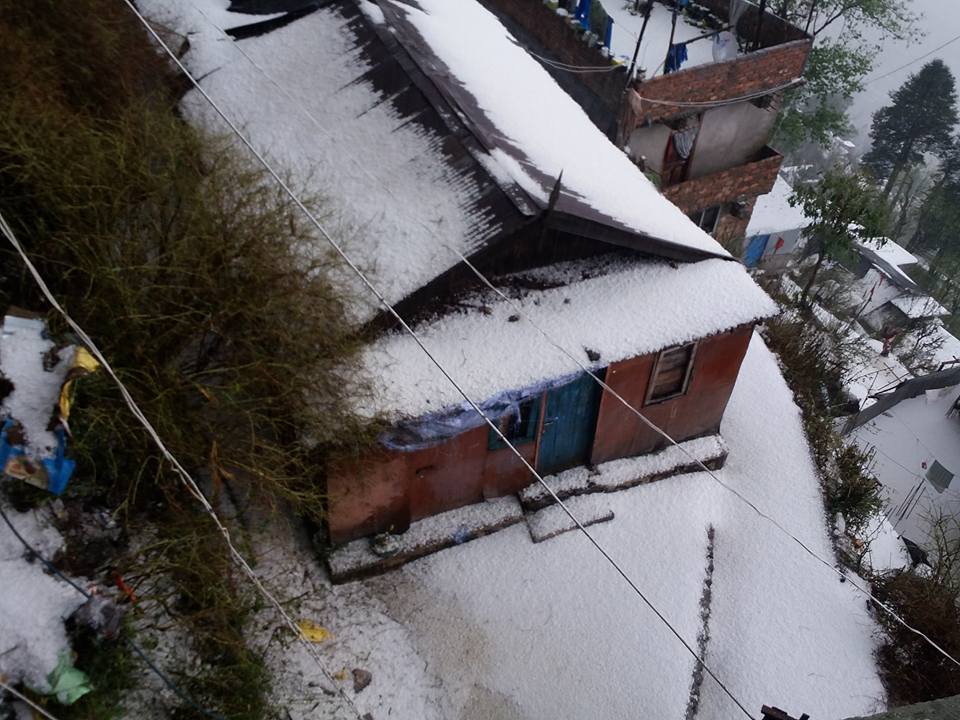
Very heavy hailstorm witnessed in Darjeeling town which was accompanied by wind and rain. Hailstones in the size of goldballs  battered roofs, trees, vehicles and people alike. Most of the places in the town received heavy hailstorm coupled with rain today. People got worried about electricity connections and transportation.

In the Morning, it was clear and sunny day in Darjeeling town but in the afternoon, it was a surprise when Darjeeling received season's first hail storm. The non stop Hailstorm is speculated to be 12 inches thick in some of the places.

The hailstorm have now finally stopped turning the hill town all white. Rahul Jha, a local resident, shared his experience on horrific hailstorm: "I haven't seen such a crazy hailstorm in my life." Soon People were out  playing with the hailstone, throwing it at others. Tourists and locals were seen taking photos at Chowrasta following the hailstorm. Spectacular sight of Darjeeling covered in hailstones... a sight many yearn for but a cause of many hardships for the residents..Will hit the tea plantations real bad.
Chowrasta in Darjeeling Hailstorm  31st March 2016
Chowrasta in Darjeeling Hailstorm  31st March 2016
Meanwhile, the vehicular movement has been widely affected in and around the town, making it difficult for the drivers to negotiate the hailstorm-filled roads.


Here are some of the photos of today's  hailstorm in Darjeeling


Khambu Rai and Limbu Development Board to be formed: Mamata Banerjee

8:32 PM

Khambu Rai and Limbu Development Board will be soon announced by Mamata Banerjee who is in a visit to Darjeeling. She is likely to announce these development boards on Netaji Subhas Chandra Bose’s birth anniversary celebration event on 23rd Jan in Chowrasta Darjeeling.

This has come as surprise to many because the Kirat Khambu Rais were fighting for Tribal status. "All India Kirati Khambu Rai Association Strongly condemn the use of our flag for the demand of Development Board. Our organisation ideology do not allow us to accept "Development Board" given by State Government of West Bengal. The use of the Flag without the permission of the organisation is unethical and crime" one of the social media post read.

"I have received several requests for setting up of development boards for various communities, among them, Khambu Rai and Limbu Board will be formed, meanwhile, we will consider for other communities too", Chief Minister Mamata Banerjee said at the concluding ceremony of Himal Terai Sports Festival 2016 held at North Point today.

She also gave away prizes at the sports festival, which was jointly organised by Siliguri Police Commisionerate, West Bengal Sports Department and Darjeeling Police.

‘I will continue to work for you always. I don't pay attention to hate-mongers. I just do my developmental work,’ she said.
‘We are providing Rs 1 lakh each to the Sherpas for their development. We have provided a grant of Rs 131 crore for uplift of the Hills communities,’ Mamata Banerjee said.

‘We are providing sports equipment and jerseys to the sports-persons who are taking part in these events. All the clubs have been granted Rs 25,000,’ she added.

She will be present during the official celebration to mark Netaji Subhas Chandra Bose’s birth anniversary at Chowrasta tomorrow.

Source The Darjeeling Times

Morcha unsure to meet Mamata on her visit to Darjeeling in January 21 to 23

8:29 AM
Gorkha Janmukti Morcha leadership is unsure of meeting chief minister Mamata Banerjee when she visits the Darjeeling hills for three days from January 21 to 23 to attend a government programme. 
Ties between the chief minister and the GJM have developed cracks ever since the former has gone on a development board formation spree since 2013 for various hill communities. The GJM maintains that the chief minister is trying to divide the hill people to curb the popular demand for a separate state. The chief minister announced a development board for the Lepcha community in 2013 followed by one for the Tamangs a year later. Last year in January, the chief minister had announced a board for the Sherpas and again in August, for the Bhutias, after which she announced no more of such boards would be formed. 

However, during her last visit to the hills in September 2015, the chief minister again said a development board would be formed for the Mangar community. She is expected to formally announce the board on January 23 at Chowrastha during the birth anniversary programme of Netaji Subash Chandra Bose. GJM leaders were tight-lipped when asked whether they would meet the chief minister. “Neither do we have information nor have we received any invitation for any government programme in Darjeeling. As such, we will not like to comment at the moment,” said GJM general secretary Roshan Giri.  Sources in the party though said it was a known fact that the chief minister has done enough to antagonise the party. 

Morcha unsure to meet Mamata on her visit to Darjeeling in January 21 to 23
Chief Minister Mamata Banerjee and Morcha Chief Bimal Gururng - a file Photo
“A decision is yet to be taken by the party on whether to meet the chief minister when she is in the hills. Given that the majority within the party feels Banerjee visits the hills only to create problems, it is unlikely that the leaderships will meet her,” one source reasoned. The Darjeeling district administration said invitations had not yet been dispatched to concerned bodies. “The January 23 programme at Chowrastha is being organised by the information and cultural affairs department and as such, I have no idea if an invitation has been sent to the Gorkhaland Territorial Administration”, said Darjeeling district magistrate Anurag Srivastav. 

Meanwhile, officials of the information and cultural affair department said an invitation would definitely be sent to the GTA soon. According to the tentative schedule, the chief minister will attend a function at the Safari Park in Jalpaiguri on January 21 and then head up to Darjeeling. On January 22, she will be present at the foundation day celebration of the Sherpa Cultural Board and prize distribution ceremony of the Himal Terai Dooars Sports Festival, the two programmes that will be held at the St. Joseph’s School ground in Singamari, Darjeeling. Banerjee will leave for Sukna on January 24 to flag off a students’ cycle rally and return to Kolkata the same day. (EOIC)

Darjeeling Cycle rally - adventure lovers initiative

7:37 AM

Writes Vivek Chhetri

Darjeeling, Jan. 1: Around 40 Darjeeling residents today pedalled across the hill town in an attempt to curb air pollution and promote the use of environment-friendly mode of transport on a day the Delhi government imposed an odd-even number restriction on vehicles.

A group of adventure lovers in the hill town had called on cyclists to pedal from Darjeeling to Sukhiapokhri, a distance of about 20km, and back.

The voluntary initiative was supported by the district administration.

Today around 10.30am, the participants, including two women and several students, turned up at Chowrasta to start the rally.

The rally began with Darjeeling district magistrate Anurag Srivastava and district police chief Amit P. Javalgi in the lead.

"When I heard about the idea, I thought it had to be promoted. There is a lot of potential for the sport (cycling) in the hills," said Srivastava who pedalled up to the Gorkha Rangamach Bhavan area.

The organisers, among whom were businessmen and bicycle enthusiasts Sangay Sherpa, Urgen Sherpa, Dawa Sherpa and Shekar Biswakarma, said the objective of the rally was to spread a message among the hill people on the need to take up eco-friendly modes of transport.

"We want to make mountain biking trendy in the hills so that people start using cycles more often. Mountain biking can also be an additional attraction for tourists, apart from its health benefits. If we can all stop using vehicles even for a single week day (in a week), it would go a long way in preserving the environment of the region," said Sangay.

In Delhi, the government policy of odd-even vehicular restriction came into effect today.

The pilot plan, which attempts to reduce air pollution in the city, would be in force till January 15.

The restriction would be in force from 8am to 8pm.

Vehicles whose number plates end with an odd digit would ply on odd dates. On even days, vehicles having even numbers would run.

The fine for violation would be Rs 2,000 under the Motor Vehicles Act.

In Darjeeling, Sean Allan Lepcha, 12, a Class VII student of St Joseph's School(North Point), was taking part in a cycle rally for the first time.

"Recently, my father got a mountain bike for Rs 80,000. When I heard about the rally, I decided to take part. I believe that we need to do our bit to save the environment," he said.

Ashwin Tamang, 11, was one of the youngest participants.

Forty seven-year-old Uday Lama, a resident of Hooker Road here, said: "I have lived at Rennes in France for a long time and there I saw people who are 70-75 years old cycle regularly. I believe that cycling needs to be promoted, mainly among younger people, who are more into computer games and hardly indulge in outdoor activities. That is why I decided to take part in the rally."

Trishna Rai, 24, a resident of Darjeeling who stays in Kathmandu where she teaches at The British School, said: "This seems such a good adventure and I have come here to participate as this is also about women empowerment. I started cycling recently and I do it whenever I come here."

Soon after the rally began, the district administration launched a Hunger Free Darjeeling initiative with local NGOs, Who Cares, Sahoyogi Hath and All India Women Conference.

Around 300 street-dwellers were given food and blankets.

The administration plans to involve NGOs, hotels, restaurants and other associations in the distribution of food among street dwellers everyday.

Source Telegraph

Darjeeling to organize 60km cycle rally on 1st January 2016

10:05 AM
Darjeeling 24 Dec 2015 Adventure tour operators of Darjeeling, with support from the district administration and the police department, will organise a 60km cycle rally on January 1 with the twofold aim of promoting cycling in the hills as a tourism activity and in helping reduce pollution emitted by vehicles. The cycling event has been christened ‘Rally for Vehicle Free Day’ and will start from Chowrastha and end in Mirik.

According to the tour operators, cycling as a tourist activity is fast becoming a fad since the past two years and the demand from tourists and locals alike have forced them to think of promoting the activity extensively in the hills. Young entrepreneur Sangey Sherpa, who is a tour operator and one of the organising members, said, “The cycle rally is being held on New Year’s day. This is symbolic as we want the year 2016 to remain pollution free.
Presently, vehicles plying in the hills are excess causing rising pollution and affecting the weather pattern. The primary objective of the event is to spread awareness among people against excessive use of vehicles in order to curb rising pollution in the region. Besides, we also want to promote adventure tourism in the hills. Darjeeling is a tourist destination with many tourist spots, and we also want to promote the region as a traveller’s destination. Tourists should get the facility of cycling in the beautiful area during their stay.”

Asserting that cycling facilities are among the key demands of tourists, Urgen Sherpa, another tour operator and also a member of the event organising committee, said, “It has been two years or so now since tourists have started showing an interest in cycling as an activity. We have started offering mountain bikes on hire. Apart from tourists, locals are also keen showing interest in the activity. About 80 bookings are done every month, except during the monsoon season.”

According to Urgen, adventure tour operators who provide bicycles on hire charge anything between Rs800 and Rs1,000 per day. He added that tourists usually prefer cycle trips in the outskirts of Darjeeling town in places such as Rambhi, Sukhaypokhari and Lamahatta. “We also offer packages that include a cycle ride up to Dhotrey from Darjeeling following which there is a trekking route to Tonglu and a night halt. The following day starts with a trek up to Manebhanjyang and back to Darjeeling. We not only offer cycles on hire, but also arrange for accommodation and food along with guides. This roughly comes up to Rs3,500 per person to Rs4,000,” said Urgen.

Speaking about the upcoming cycle rally, Sangey said, “Until now, 60 people have registered for participation in the cycle rally and many more are expected to join on the day of the event. We believe the message of using vehicles in a limited manner will spread further.”

(EOIC)

Downhill in Darjeeling - Prajwal Parajuly 

9:16 AM

Writes: Prajwal Parajuly 

At Tiger Hill, Darjeeling’s famous viewing point, stands an observation tower. As early as 5am, the bottom two floors of the tower are already crammed with standing tourists. We are on our tiptoes—there’s no room. The top deck isn’t crowded. Tourists there sit on sofas that were once plush and sip tea while men stand guard at the door. These men forbid us from entering.

“No tickets,” they say in English. “Sold out.”

We say we’ll pay extra. They say all the seats are taken.

We say we’ll stand. They say that would be obstructive.

One of us speaks in Hindi. It doesn’t work.

One of us tries broken Bengali. They glare at us.

I make a final request in Nepali. They let us in.

“Aye, we thought you were Bengalis,” the burly bouncer at the door says. “You should have told us right away, and we would have let you in.”

“What if we were Bengalis?” I ask, self-righteous now that I’ve already been the beneficiary of this one-sided ethnic rivalry.

“Then, we would maybe only allow you in if you paid us.” The bouncer cackles. His friends hoot.

“That’s discrimination,” I say.

“For good reason,” the bouncer replies.

Inside, the windows are giant, the sofas comfortable enough to snooze on when the mountain—or the sun—decides to delay appearance, and if you fancy closer Kanchenjunga views, you can perch yourself on stools right by the windows. Back in the day, this viewing deck might have been cosy, even luxurious. But it’s in disrepair now. Paint is chipping off. Walls are cracked. The rugs covering some sofas are threadbare. The bathroom needs water.

Around us, mostly Western tourists, bleary eyed yet hopeful, tinker with their cameras and wait.

“It will rise today,” the burly bouncer promises. “It will.”

“Did you see the sun yesterday?” I ask. Early November is usually a great time to visit Darjeeling, but it had been a gloomy few days.

“Yes, we did,” the bouncer replies. “And the day before.”

We amuse the bouncer and his friends. We are from Sikkim, right next door, and yet we’ve dragged ourselves from bed in the cold, even before the crack of dawn, to see what we’ve been taking for granted all our lives.

“You people are behaving like exact tourists,” the bouncer jokes. “One of you must even have a monkey cap.”

We deign to laugh. He’s being snide about balaclavas, favoured by Bengali tourists, who descend on Darjeeling and neighbouring areas in droves. Singara tourists, the locals call them. Travellers on a budget who’ll haggle you down to the last rupee. Their money-spending capacity notwithstanding, the sheer number of these tourists have kept tourism alive in these hills for years.

I ask Prakash, who says he’s not a bouncer but a part-time guide, why the place isn’t well maintained.

“What do you expect, mams (brother)?” he says, slipping into lingo that’s archetypically Darjeeling. “This is Darjeeling. Do you think Bengal cares? Why shouldn’t we hate Bengalis? They’ve robbed us of all our tourism and tea revenue, and we are left with nothing. No money. No Gorkhaland. Nothing.”

“But hasn’t there been some development in the last few years?” I ask.

And that’s invitation enough for Prakash to segue into a 45-minute diatribe on everything that’s wrong with Darjeeling. As the clouds part to make way for the sun to reticently emerge and weave its magic in the sky, Prakash asks me if a place like Tiger Hill would be as poorly maintained in Sikkim. I say it wouldn’t. When shutter-happy tourists scuttle from one end of the room to another for views of the mountain changing hue, Prakash fills me in on the ill- treatment meted out to Darjeeling by West Bengal

Every trip to Darjeeling I’ve taken as an adult leaves me sadder than the last. Nature continues being bountiful. Man continues being destructive.

The click-clacking of horses on the Chowrasta, Darjeeling’s pedestrianized square, is enough to transport me to happier, carefree days. We often spent weekends here when I was a child. Gangtok, my hometown, was a long way from becoming as shiny and Swiss as it is now. Darjeeling was only a 4-hour drive away. A trip wouldn’t be complete without horses to ride on at the square, cakes to feast on at Glenary’s and schools to visit, where, it was understood we’d board for a year or two when we grew older.

Of course, the town—and all of North Bengal—was in the midst of gargantuan problems. The Gorkhaland revolution—that impassioned movement that everyone here hoped would result in the creation of the Nepali-speaking-majority state of Gorkhaland, a separate entity from West Bengal—had reached its crescendo in 1986-87. The Nepali-speaking people of West Bengal, the majority of whom live in the Darjeeling hills, demanded statehood on linguistic and ethnic grounds. It was an often-violent movement, and clashes between the agitators and the CRPF personnel were frequent. Curfews, months-long strikes and killings were normal.

Yet my family was undeterred. The minute we’d hear of things returning to normalcy, we’d pack our bags for a weekend away. We made frequent trips because Gangtok didn’t have a decent bookstore in the late 1980s. Darjeeling’s Oxford Bookstore, bang in the middle of the Chowrasta, was where I purchased my first Puss In Boots book. We went because all of us cousins had unending hankerings for the chocolate éclairs at Glenary’s. We went because the Windamere Hotel, where, we were told, the last king of Sikkim courted the American Hope Cooke, charmed us. We went because we loved to see tea leaves being crushed and curled at the many tea gardens. We went because the Kanchenjunga was visible from far more points in Darjeeling than it was from Gangtok. We went, above all, because we couldn’t get enough of Darjeeling’s toy train, songs about which—Darjeeling’s little train/is ready to start/Listen to the whistle of the guard, brother/the train’s ready to chug along—had been our lullaby since the day we were born.

It was to capture the magic of this era, to relive a bit of our childhood, that we took our most recent trip to Darjeeling. Well-meaning people had warned us. Everyone said we’d be disappointed. We reasoned that if we loved Darjeeling at the peak of the agitation, it couldn’t be so bad now. We were prepared for the worst. We were prepared to return sadder.

If reports are to be believed, all Indian hill stations are going downhill.

No piece on Kashmir spares an allusion to the gross commercialization of Srinagar. Rampant construction is proving to be Mussoorie’s undoing. Ooty has its trash problem. The monkeys in Shimla are a menace. The roads to Gangtok are horrendous. Café Coffee Days and Subways make all hill stations look like clones. Darjeeling’s biggest problem is that it hasn’t quite recovered from the agitation of the 1980s, which spawned several smaller movements, some of them as recent as two years ago. The movements—almost always accompanied by strikes, the closing down of schools and the blocking of the national highway—have done more bad than good. Add to this a state government with whom the local government is perpetually at loggerheads, and the result is massive infrastructure deficit, manifestations of which we could see at the Tiger Hill viewpoint and everywhere else in Darjeeling. That the district is a tiny, tiny part of a big state doesn’t help. The affluence of Sikkim, Darjeeling’s closest neighbour, into which the Central government funnels huge amounts of money, pinches hard.

Phurba, our driver for much of the trip, claims to have participated in the 1980s’ agitation. He says he was shot but doesn’t show us bullet marks when we ask him. Like almost everyone we speak to, he has had it with the West Bengal government. I ask him what his children do.

“Call centres in Delhi,” he says as he manoeuvres a serpentine bend toward the Padmaja Naidu Himalayan Zoological Park, where we want to see pandas. “The older one stuck around for four years after graduating from college. But there are no jobs here.”

Darjeeling’s decline is evident not just in the trash-strewn streets, the lack of water and buildings standing cheek-by-jowl but also in the rapidly dwindling youth population. Everyone complains about the absence of opportunities.

“Will they ever come back?” I ask as we whizz by lush green hills of tea. We’re barely 3km from the square, the heart of Darjeeling’s concrete jungle, and here’s 400-plus acres of pure greenery in the form of the Happy Valley Tea Estate. As though to compound the estate’s picture-perfect quality, women plucking tea leaves and depositing them into their doko baskets soon come into view.

“Only when Gorkhaland happens.”

There’s the G-word again. People may be disillusioned with their leaders. They may have little hope in their government. They may encourage their children to move to greener pastures. But everyone believes—fervently believes—that Gorkhaland will happen.

I express pessimism about Gorkhaland. Phurba isn’t too keen to discuss further.

“Don’t forget to see the Royal Bengal Tiger,” he says. “And make sure you see the (Himalayan Mountaineering) Institute Museum.”

We are let off.

The agitation of the 1980s led to the creation of a semi-autonomous body called the Darjeeling Gorkha Hill Council. Since then, the demand for statehood has been the background score to almost all movements. Semi-autonomy has been the greatest extent to which the state and Central governments have budged. Yet another movement that started in 2007 under a different political party led to, five long years later, the abolition of the Darjeeling Gorkha Hill Council and the creation of the Gorkhaland Territorial Administration, supposedly slightly more autonomous than the Darjeeling Gorkha Hill Council. To the masses, there’s little difference.

We are in a meat eater’s paradise called Keventer’s. On the plate in front of me are strings of bacon, ham, salami and sausage. To my opposite are two vegetarians. A hand-written sign on a poster across the street arrests my attention.

“WE BELONGS TO SAME IDENTIFICATION AND COMMUNITY,” the poster reads. “LET WE DO UNIFICATION SIKKIM.”

I do a double take. I ask our waiter what he thinks of the proposed merger with Sikkim.

He’s a Bengali from Jalpaiguri. He doesn’t care.

“Would you like to be merged with Sikkim?” I ask a different waiter.

“I’d like Gorkhaland,” he says. He has a hopeful look.

“And if that’s not an option?”

“The second best thing would be to merge with Sikkim. We were once one.”

That’s true. Darjeeling was a part of the kingdom of Sikkim until 1780, when Sikkim surrendered Darjeeling to Nepal. When the British defeated the Nepalese in the Anglo–Nepalese War of 1814–1816, Nepal was forced to cede Darjeeling to the British East India Company. In 1817, the British returned Darjeeling to the king of Sikkim. So, yes, the Sikkim-Darjeeling merger talk has a historical backbone.

“Like Sikkim would be willing to share her fortunes with you,” I say.

“They have to help us out,” the waiter says. “We are basically the same people.”

“But think of all the trouble you’ve given us—we miss so many flights because you close off the national highway. There’s no other way for us to get to the airport.”

“But we have more in common with people in Sikkim than we do with Bengalis. Our festivals are the same. We speak the same language. We have the same culture. It only makes sense.”

“And all the schools you close off knowing that our children study here. How do you expect support from Sikkim when you’ve made so much trouble?”

The waiter doesn’t know what to say. I am aware I’ve put him in a spot.

“I know you personally didn’t cause me to miss my flight,” I say. I apologize.

We pay the bill and head to Glenary’s. The éclairs are smaller than we remember them. We can’t say if the taste has changed too. Someone at The Buzz, the basement bar at Glenary’s, shows me a picture when I bring up the issue of the Darjeeling-Sikkim merger.

“DARJEELING BELONGS TO SIKKIM. SO DARJEELING UN …” The rest of the poster has been ripped off. 

The Chowrasta, Darjeeling’s square, still smells like horse manure. I enjoy the smell. Of all the mall roads in India, this is my favourite. Gangtok’s square is too sanitized; almost all the old buildings have been torn down. The Chowrasta is dirty in comparison. Some of the stores are housed in buildings that look like they are about to collapse. One of these ancient shops is the Oxford Book & Stationery, that store of my childhood. I still have that tattered copy of Puss In Boots in my New York apartment.

I’ve promised Maya, the owner, that I’ll sign copies of my books when I am in town. As I make my way in, I marvel at the presence of a massive bookstore—so unapologetic about its size—in this location, the best possible site in Darjeeling. Oxford employs six full-time employees, one of whom, Maya says, has been with her family for more than 50 years, and another for 47. The store is spacious, conducive to browsing and well stocked. Maya says tourists this year have been few. If the number of people in the store is any indication, she doesn’t need to worry about business. The store has no problem with footfalls, I point out.

“Not everyone who’s here buys a book,” she says.

“That’s true.”

“But that’s fine. That’s how book stores should be.”

“Haven’t you been tempted to abandon the book store and open something else, do something more lucrative?” I ask. “I mean, this is prime real estate.”

“This place will always be a book store,” Maya says, with finality.

I am filled with affection for this lovely space. It reminds me of all the great book stores in my life—places that made me a writer and are now supporting me as a writer.

Outside, the clouds have vanished. The mountain wows us. The weather hadn’t been very cooperative on the day we went to Tiger Hill. Today is different. The sky is a brilliant blue. Here’s the Kanchenjunga—so close, so confident, so generous—standing sentinel over the hills. We give up taking pictures. We don’t want to trivialize the mountain, the moment.

Soon, the mountain recedes. A sarangi player restrings his instrument while his partner prepares to sing something folksy. A pony neighs and defecates on someone’s shoe. Tourists are alarmed. Locals laugh. A nervous young girl circumnavigates the square on horseback. From a makeshift stage a politician’s rants echo. He says something about Gorkhaland and unfulfilled promises. The crowd breaks into raucous applause. 

Source : Live Mint

Darjeeling police have decided to gear up security in tourist season

11:26 AM
With the tourist season drawing near and a festivity mood in the air, Darjeeling police have decided to gear up security in Darjeeling.

Superintendent of police (SP), Darjeeling, Amit P Javalgi on Monday said the police will intensify patrolling in various places of Darjeeling and also install CCTV cameras at 15 significant points in the town. He added that a 24-hour control room with multiple phone numbers for police assistance will be made effective soon.

The announcements were made after the Darjeeling police conducted an interactive meeting with the Hotel Association of Darjeeling on Monday. Sources said that the objective of the meeting was to make Darjeeling ‘tourist friendly’ and to establish a cordial relation between the Darjeeling hoteliers and the police.

“Mall road, which is located near Chowrastha does not have any lights. Once it gets dark, the road becomes a hub of drug addicts. I request the police to introduce patrolling there,” said one of the Hoteliers in the meeting.
Darjeeling police have to gear up security in tourist season
Darjeeling
Increase in police patrolling in places such as Mall road, near Chowrastha, Jalapahar, Coochbehar road, and TV tower in Darjeeling was suggested by various hoteliers who claimed that these roads are a hub of drug addicts from evening.

The hoteliers also requested the SP to have arrangements made for electricity supply to some roads in Darjeeling, and to take measures against the increasing number of dogs in some roads near the hotels. Javalgi said he will pursue the matter with the municipality at the earliest.

Another hotelier raised concerns regarding the speed of two wheelers in the area that extends from Chowrastha to Governor’s Palace and said, “The road is used by several pedestrians, both tourists as well as locals and yet we witness two wheelers being driven in extremely high speeds.”

“Traffic infrastructure will be renewed and we will make use of all we have to ease the traffic problem,” Javalgi added.

According to Javalgi, another meeting between the hoteliers and the Darjeeling police will be held in December after the implementation of the security measures.

Via ISL


Bengal Government Associated With Madan Tamang Murder? - Public Liberation Association

6:24 PM
Faiyaz Shafique Ansari for TheDC

Poster by "Public Liberation Association" Pasted on Bhanu Bhakta Statue in Darjeeling Chowrasta Asks "Is Bengal Government Associated With Madan Tamang Murder?"

A poster pasted on Bhanu Bhakta statue at the heart of Darjeeling - Chowrasta by a group, which calls itself "Public Liberation Association" has caused mild sensation in the town.

The poster reads, "The PLA party wants to inform the general public that in 2001 GNLF supreme Subash Ghising was attacked at Sat Ghumti, after a few months the Bengal government arrested the revolutionary leader Chattra Subba from near Indo-Nepal border. Bengal government put Chattra Subba in jail for 11 years, without any proof.
Is Bengal Government Associated With Madan Tamang Murder? - Public Liberation Association
Poster by "Public Liberation Association" Pasted on Bhanu Bhakta Statue in Darjeeling Chowrasta
Then on May 30, 2010 our Gorkha leader Madan Tamang jiu was murdered in broad daylight, the government has adequate proof against those who are involved, and despite that the government has not done anything to arrest these murderers.

Could it be that the Government is in cahoots with the murders???

The Bengal needs to answer our query at the earliest"

It is signed PLA and a stamp is also affixed.


Via The Darjeeling Chronicle

Mamata Banerjee launched “Clean Darjeeling Green Darjeeling”

5:34 PM
Mamata Banerjee launched Rs. 500 crore “Clean Darjeeling Green Darjeeling” today from Chowrasta in Darjeeling. Bimal Gurung, Chief Executive, GTA, Minister Arup Biswas, Chief Secretary and other senior officials of the state and the GTA were present in the launch of the programme  which is the joint initiative of the West Bengal state government and the GTA. 53,000 toilets will be built across the Darjeeling district under the project.

Mamata Banerjee had arrived at Darjeeling yesterday evening for the event. Sanitation, Water conservation through rainwater harvesting, Waste management, Green cultivation through afforestation and Development of horticulture were some of agendas.
Mamata Banerjee launched “Clean Darjeeling Green Darjeeling”
Mamata Banerjee launched “Clean Darjeeling Green Darjeeling” 
After launching the “Clean Darjeeling Green Darjeeling” Mamata Banerjee made the statement in her FB page.

I am in Darjeeling. I love this beautiful place and its people so much that I come here again and again.

Today is a very significant day for Darjeeling. I launched the “Clean Darjeeling Green Darjeeling” initiative today from Darjeeling Chowrasta.

A joint initiative of the state government and the GTA, “Clean Darjeeling Green Darjeeling” will run on a mission mode to ensure clean living in Darjeeling with sanitation facilities in homes and community sanitary complexes, solid and liquid waste management, ban on plastic bags, cleaning of springs (jhoras) and roadside plantation.

It will encourage water conservation through rainwater harvesting in rural and urban areas and spring shed development and green cultivation through afforestation, development of horticulture and medicinal plants that will also boost the local livelihood.

Bimal Gurung, Chief Executive, GTA, his colleagues in the GTA, Minister Arup Biswas, Chief Secretary and other senior officials of the state and the GTA were present in the colourful programme.

Thousands of school children and others took oath on the occasion for clean and green Darjeeling.
It is our mission to restore the Queen of Hills to its pristine glory. It is our commitment to our future generation.

Let us all work together towards achieving this.
My best wishes to everyone.

Later Bimal Gurung on his Facebook Page wrote "Thank you Ms Mamata Banerjee, Hon'ble Chief Minister of West Bengal for the wonderful initiative of Clean and Green Darjeeling, which is critical and timely, as the burden of waste in the Darjeeling Hills is ever increasing.

A new comprehensive solid and liquid waste management project will be setup in Darjeeling.
More than 50000 toilets will be built in rural places in GTA area.Rain water harvesting projects will started in Educational institute in the hills and various afforestation programs to be introduced in GTA area.

Now its up to us to make this project a success and the people of Gorkhaland Territorial Administration Area must use this project to make our our hills, The Queen of the Hills."

Baba Ramdev's visit to Darjeeling have nothing to do with politics - Bimal Gurung

8:54 AM
Upon his much-awaited arrival in Darjeeling this evening, yoga guru Baba Ramdev skirted questions on the demand for a Gorkhaland state saying it was a political issue. In the same breath however, he said he respected the sentiments of the people.

On his maiden visit to the Darjeeling hills to conduct a three-day yoga camp from April 17 to 19 being hosted by the Gorkhaland Territorial Administration, Ramdev received a humongous welcome as he arrived in a motorcade from Bagdogra airport.

Baba Ramdev's visit to Darjeeling have nothing to do with politics - Bimal Gurung
Baba Ramdev's visit to Darjeeling.
Sitting astride his disciple Balkrishna Acharya and GTA chief executive Bimal Gurung, the yoga teacher said, “Gurungji is here to talk about Gorkhaland. It is a political issue and is attached with the sentiments of the people. However, any issue that is in the interest of the nation and its people will always get my respect.”

When asked about the actual purpose behind Ramdev’s visit, Gurung said it was his long cherished dream to bring the yoga master to the hills for a camp.
Baba Ramdev's visit to Darjeeling
Baba Ramdev in Darjeeling
“Please, let me make it clear that Baba Ramdev is here to conduct a yoga camp and his visit has nothing to do with politics,” said Gurung.

Baba Ramdev will conduct the camp from 5am to 7.30am at Chowrastha. We have placed 15 LED screens in and around Chowrastha and at the Gorkha Ranga Manch Bhawan.”

The GTA has also requested Ramdev to establish a unit of the Patanjali Yogapeeth in Darjeeling and he has replied in the affirmative. “I have been asked to set up a Yogpeeth in Darjeeling. The Himalaya and the northeast region are a treasure of trove of several medicinal and herbal plants. You will get a unit of the Patanjali Yogapeeth very soon,” said Ramdev. Gurung said the GTA would identify the land for the Patanjali Yogapeeth unit.

During his stay the yoga guru will inaugurate a steel bridge at Jogi Ghat in Mungpoo, 28km from Darjeeling. The bridge will connect Mungpoo with Latpanchar.

Source: EOI

 
Copyright © Indian Gorkhas. Designed by Darjeeling Web Solutions